Categories
Arts & Life Featured

Exclusive interview with B.o.B.

By Courtney Flagg

News Editor

Courtney Flagg ’12 chatted with B.o.B. in an interview Friday night before the fall concert to discover the real Bobby Ray.

Q”: You started off in a group called Klinik. What made you decide to continue with music as a solo artist?

A: It was really just a matter of interest. My cousin wanted to go to college to learn business, and I wanted to jump in [to the music industry] and learn from experience, so we kind of just went separate ways. In 2006, that’s when I got signed.

Q: So you knew you wanted to continue with music. Nothing else?

A: There was no Plan B. Plan B was to start from Plan A again.

Q: You have collaborated with a lot of different artists. When you write your songs do you have certain artists in mind?

A: Not really, unless I’m making something with the artist there, usually it depends on who I may run into each time we have to get a song done. If it’s not a lot of time usually it will just be the artist on a song that’s already finished—they might just be featured on it.

Q: What determines whether or not an artist will work with you on a song?

A: Really the artists are typically very busy, unless they’re just recording. It usually just depends on who you run into. Honestly, it’s just if the stars align in the right way, because even if you do meet someone you might want to collaborate with, they may be in a different vibe or it may be hard to get them in the studio. Really I think it’s just meant to happen because I wish I could work with a lot of different artists. The probability of that actually happening is so slim. It really just depends.

Q: If you could work with any artist, dead or alive, who would that be?

A: Picasso.

Q: Picasso? Would you be working on something musical with him?

A: I don’t know. It would be a combination of both.

Q: A music video?

A: It would be a music gallery.

Q: Your music videos are really creative. How do you think of them?

A: I think I’m still learning about how to reflect my music in my music videos. Each video that you do continuously gets better. Even still, I have many different places I want to go, that I want to show people.

Q: What would those be?

A: You just have to wait until the next album to find out.

Q: When does your next album come out?

A: I don’t know yet, it’s still being recorded. But I am releasing a mixed tape this December.

Q: Are any different artists collaborating on that one?

A: Just me and Bob.

Q: You play a bunch of different instruments. How did you start?

A: Well first I started out playing the spoons, then I moved onto the kazoo. Eventually, in sixth grade I started playing on the desk. Now I play the guitar, the trumpet and the piano and a few other instruments.

Q: What inspires you to write songs?

A: The inspiration comes from life experiences. It comes from meeting people. It comes from shows. It’s really just me taking my interpretation of reality here and putting it into a comprehendible song and making music with it.

Categories
Uncategorized

PSafe Log Week 9

Wednesday, Oct. 27

ALARM/INTRUSION

Computer Center: Caused by employee.

EMS TRANSPORT

Moore Avenue: Hospital transport.

Thursday, Oct. 28

PROPERTY/LOST

Gerhard Fieldhouse: Under investigation.

PROPERTY/LOST

Swartz Hall: Property found.

Friday, Oct. 29

DRUG VIOLATION

Smith Hall: Report filed.

THEFT

West Fields: Under investigation.

PROPERTY/FOUND

Kress Hall: Report filed.

THEFT

Bucknell West: Under investigation.

THEFT

Bucknell West: Under investigation.

ALARM/FIRE

Kress Hall: Detector malfunction.

ALARM/INTRUSION

Dana Engineering Building: Cause unknown.

LIQUOR LAW VIOLATION

Gerhard Fieldhouse: Report filed.

EMS TRANSPORT

Gerhard Fieldhouse: Student transported.

SMT TRANSPORT

Gerhard Fieldhouse: Student transported.

LIQUOR LAW VIOLATION

Gerhard Fieldhouse: Report filed.

DISORDERLY CONDUCT

Gerhard Fieldhouse: Report filed.

ASSIST/MEDICAL

Gerhard Fieldhouse: Assisted by EMS.

DISTURBANCE

Gerhard Fieldhouse: Unfounded.

LIQUOR LAW VIOLATION

Gerhard Fieldhouse: Report filed.

ASSIST/MEDICAL

Gerhard Fieldhouse: Assisted by EMS.

LIQUOR LAW VIOLATION

Gerhard Fieldhouse: Report filed.

NOISE COMPLAINT

Kappa Sigma Fraternity: Warning issued.

DRUG VIOLATION

Smith Hall: Unfounded.

Saturday, Oct. 30

EMS TRANSPORT

Bucknell West: Hospital transport.

LIQUOR LAW VIOLATION

Smith Hall: Report filed.

ALARM/INTRUSION

Elaine Langone Center: Cause unknown.

PROPERTY/FOUND

Bucknell West: Call made to owner.

THEFT

Upper Campus: Under investigation.

ALARM/FIRE

Phi Gamma Delta Fraternity: Caused by steam.

ALARM/FIRE
Bucknell West: Caused by smoke.

DRUG VIOLATION

Bucknell West: Under investigation.

EMS TRANSPORT

Harris Hall: Under investigation.

TAMPERING WITH FIRE EQUIPMENT

Phi Kappa Psi Fraternity: Under investigation.

Sunday, Oct. 31

EMS TRANSPORT

Theta Chi Fraternity: Transported to hospital.

DISORDERLY CONDUCT

Vedder Hall: Warning issued.

CRIMINAL MISCHIEF

Vedder Hall: Under investigation.

CRIMINAL MISCHIEF

Gateway Roser: Under investigation.

CRIMINAL MISCHIEF

Sigma Phi Epsilon Fraternity: Under investigation.

PROPERTY/FOUND

Sojka Pavilion: Report filed.

Monday, Nov. 1

THEFT

Marts Hall: Unfounded. Item located.

ALARM/INTRUSION

Financial Aid Office: Caused by employee.

WELFARE CHECK

Taylor Street House: Contact made.

Categories
Opinion

Energy drink too ‘Loko’ for students?

By Lizzie Kirshenbaum

Contributing Writer

For years, students ranging from middle school to college age have received education concerning the effects of alcohol. Within this subject, the theory of “moderation” has been strongly emphasized. Parents and educators have recognized the impracticality of doing away with all underage drinking and have implemented programs to teach how to drink safely if at all. The University, among many other colleges and universities, requires first-year students to take an online course, “AlcoholEdu.” This course contains an extensive series of lessons and videos pertaining to the risks of drinking.

But as the popularity of the alcoholic beverage “Four Loko” soars, individuals are suffering the effects of alcohol from the worst end of the spectrum. This has caused college authorities to institute total bans on the beverage. The current argument is that alcohol may be reasonable in moderation but not when coupled with caffeine even in a moderate serving.

Researchers have released statements noting the high risks of mixing a depressant with a stimulant. The caffeinated ingredient in the drink causes consumers to prolong the feeling of being intoxicated, causing them to drink more heavily. Additionally, one can of Four Loko, which has a 12 percent alcohol content and 135 milligrams of caffeine, is the equivalent of six servings of beer and approximately two cups of coffee.

While the obvious dangers lie within the ingredients of the product, the company defends its product by stating that it is only to be consumed by responsible adults. Four Loko’s website page on “Responsible Drinking” states: “as a responsible member of the alcoholic beverage industry we take seriously our obligation to market our products only to adults 21 and over.”

The authenticity of this statement is apparent when one accesses the website and must type in his or her birth date, for anyone under the legal age of drinking is barred from entering. Fortunately, at 18 years old I have the creative mind to change the year of my birth in order to access the site. Similarly, I’m sure there are many other resourceful 18-year-olds who can figure out how to purchase Four Loko products despite the 21+ labeled bottles and proposed cautions taken by distributors.

Vice President of the Caron Treatment center and addiction specialist, Harris Stratyner, has attested to the fatal dangers proposed by the drink to people of any age. Phusion Projects, the company that manufactures Four Loko, has stated its products are safe for consumption despite current FDA investigations. The company stresses that the mix of alcohol and caffeine is “nothing new.”

Taurine, one of the four main ingredients of the drink, is the same active ingredient as in Red Bull. One may compare drinking a can of Four Loko to taking a shot of hard liquor and then immediately drinking Red Bull as a chaser. Although neither act portrays good judgment, the latter seems to be the lesser of two evils, at least according to recent physical reactions to Four Loko.

All of this recent hype leads to an important question: Should the University join the movement to ban Four Loko products on campus? In my opinion, the students were admitted for their intelligence, and it is the responsibility of those students to make decisions for themselves. If the recent news of college-age students’ hospitalization for heart attacks does not deter students from consuming Four Loko, why would a campus policy hold any more clout?

Categories
Opinion

Democrats need new plan after elections

By Eric Soble

Opinions Editor

Driving political activist Paul Loeb back to Harrisburg airport earlier this week, I remember talking at length about the absolute trouncing moderates had undergone in this week’s election. Democrats had lost 60+ seats in the House, making this the largest Republican victory since 1948. Republicans had also gained six Senate seats, a more modest success. President Obama admitted that this election was “humbling” and acknowledged that this would stall the creation of a comprehensive climate change policy as well as thwart Democrat efforts to continue Obama’s job creation agenda. After I vocalized this pessimistic yet truthful analysis, Loeb paused for a second and said something that still sticks out in my mind: “Disappointment is inevitable. It is what you do after disappointment that truly matters.”

Democrats and Independents cannot afford to do what they did after 2008—wash their hands of activism and become overly confident in the powers of a supposedly messianic figure. Simply put, a lot of us got lazy. We believed in the unbelievable and allowed ourselves to go about our daily lives, hoping someone above us was working hard to fix the nation.

The stakes are even higher now. In the lead up to 2012, the Democrats must reassert their goals for America and recalibrate their strategies for achieving these goals. They must rely upon compromise in some areas and maintain their ground in others. Compromise between parties may be easiest when it comes to government reform—abolishing the filibuster, agreeing on campaign finance reform, cutting unneeded spending, etc. But it may prove difficult in economic and social matters, such as healthcare reform, equality for sexual minorities and moving out of Afghanistan.

In this political climate, the main question left for the President is this: fight or flight? He must choose his battles wisely if he wishes to continue on after 2012. The two most contentious debates will concern the Bush tax cuts and the healthcare bill. These will surely be complex and lengthy issues to face, and will take up much time and energy. It is near impossible to predict how these will play out, but one thing is for sure: neither side will be happy.

Here are some fights the President can win:

  • Sign an executive order repealing “Don’t Ask, Don’t Tell.” A May 2010 Washington Post/ABC News poll shows 75 percent of the nation believes it should be repealed. There is no good reason not to act on this now.
  • Combat the contradictory statements of the Tea Party. This party is a noxious branch of Republicans that wishes to travel back to an imagined “golden age” of our Founding Fathers. They do nothing but drain energy away from the political process and distract the public from the issues at hand.
  • Move forward on climate change and responsible energy policies. The President cannot wait for the global warming denialism on the right to catch up to 21st century scientific fact. He should not compromise with representatives like John Boehner—the likely Speaker of the House—who think carbon dioxide emissions are not harmful to our planet.
  • Reduce the deficit and cut the defense budget. The president should reign in spending on trillion dollar wars overseas. This does not mean sacrificing our armed forces or our security but rather ensuring a maintainable and efficient military force. This would force the so-called “economic conservatives” elected on Nov. 2 to show that their ideology can be evenly applied across the spectrum.

The next two years may be an exercise in extreme partisanship and frustrating gridlock. The “change we can believe in” slogan was great for 2008, but it could stand an addendum in 2010. Maybe “change we can feasibly accomplish in a limited number of months given our political and economic constraints” would be more apt. It surely isn’t as catchy, but it is something we can run with.

Categories
News

Low youth voter turnout for midterm elections

By Tracy Lum

Editor-in-Chief

In the 2010 midterm elections, 12,040 of the 22,383 registered voters in Union County cast ballots Tuesday, according to the Union County Bureau of Elections.

The approximate 54-percent voter turnout rate was comparable to that of the 2006 midterm election, said Greg Katherman, director of elections and voter registration in Union County.

“Almost the same number of voters voted,” he said in a phone interview, though he could not provide a definitive percentage comparison. The voter turnout was up from roughly 33 percent in the spring primaries, he said.

For the presidential election in 2008, Union County polls reported an approximately 72 percent voter turnout rate. Though Katherman anticipated a 60 percent turnout for the midterm elections, he said some people did not come out to vote because they did not perceive this election to be as important as the presidential election.

“My guess is that … younger voters didn’t come out in this election, whether it’s college kids or young working people,” Katherman said.

Looking at the age demographics from voters in the election, he said a more senior group came out to vote. Full data on voter demographics in Union County will not be available for two weeks, but according to a national exit poll conducted by CNN, about 11 percent of the electorate was between the ages of 18 and 24 and about 23 percent was age 65 or over.

Students from the University registered to vote in Union County cast ballots in one of four polling locations: Larison Dining Hall, the Weis Center for the Performing Arts, the Donald Heiter Community Center or the Union County Courthouse. The proper voting location depended on where students lived on campus when they registered to vote, unless they notified the government center of the address change.

Some students were confused about where to vote. Elliot Franz ’11 did not figure out his polling location until two hours before the polls closed. He noticed a lack of information and discussion about the election on campus, especially compared to the array of posters, signs and pamphlets that decked the campus two years ago.

“Nobody really talks about it,” Franz said, “but I think this election makes more of a difference than the presidential election in some respects.”

Other students believe that people were not well informed about this election.

“I feel that because of the Bucknell Bubble and the disconnect between many Bucknell students and the people of Lewisburg, many students were not even aware until it was too late to register that midterm elections were taking place,” said Sarah Coppock-Pector ’13, an intern at representative Chris Carney’s office in Lewisburg. Coppock-Pector and fellow intern Lucy Christensen ’12 focused their efforts on Snyder and Union counties instead of on campus.

Daniel Murphy ’11 said he did not vote in the election because he did not know who was running in the area.

“I didn’t want to vote when I don’t know the issues being discussed and what each candidate stands for, which comes off as irresponsible,” he said. “I know more about the candidates running in my hometown just from being home for three days … than I do of the candidates in this area.”

Scott Meinke, associate professor of political science, said the lower turnout of younger voters for midterm elections could be explained by their mobility.

“They’re more mobile, less likely to be motivated by the kinds of local connections that help get people to the polls,” he said in an e-mail.

Still, he said young voters participate in elections when candidates make serious efforts to engage the younger demographic.

“We didn’t see as much of those trends in this year’s midterm election,” he said, “so it’s not surprising that the electorate skewed older as the campaigns spoke more to older voters in issues and in organizational efforts.”

Categories
Editorial Opinion

Editorial

Two years ago, Obama and McCain political propaganda swamped campus in a sea of red, white and blue. Posters, signs and stickers covered bulletin boards from top to bottom, and students donned supportive buttons. Chalked messages on sidewalks encouraged people to vote, while student activists marched through dormitories, knocking on doors to persuade other students to register to vote.

The same political organizations that so ardently promoted their candidates on campus made no similar campaign in the 2010 midterm elections. In fact, if it weren’t for the political ads on TV and the briefly advertised election panel discussion on Oct. 21, most students would have had no idea the election even occurred. The lack of interest in voting signals to us a failure of many students to become engaged and informed citizens.

While many may argue that the propaganda from two years ago spawned conflict and provided no real information, we believe having at least some information is better than none. Placing posters, signs and pamphlets in prominent locations around campus reminds students to take part in the democratic process. It also encourages students to conduct research and practice their analytical skills when deciding which candidates’ positions align best with their own interests.

Moreover, in the past, these organizations helped students register to vote in Union County. This time, many underclassmen were uninformed about how to register. Others didn’t know enough about the candidates or where they could even vote. While the political groups may have their own agendas at election time, they are usually successful in increasing voter awareness and turnout. Their absence this year was felt at the polls on campus.

The overall lack of information about the election on campus was disconcerting. Rep. Chris Carney (D-Pa.) even held an open forum on campus on Oct. 12, but the event was not well publicized.  Some professors mentioned the election during their classes, but few were able to convey the importance of the outcome on students’ lives. Many students believed their votes would not matter.

Still, we cannot fault political organizations alone for a subdued effort.  We as students are given the right to vote and we should exercise that right. If we are unwilling to go out of our way to gain more information about the election and its candidates, that is really no one’s fault but our own. It is unfair for people to arbitrarily choose names on a ballot, but it is also a travesty that we will not make a substantial effort to understand the policies that will undoubtedly affect us in the future.

Categories
Sports

Men’s rugby wins playoff game, 13-12

By Cooper Sutton

Sports Editor

On a windy pitch behind the University soccer stadium, the Bison rugby team beat Lafayette this Saturday 13-12 to win its first-round playoff game.

Coming off of a loss to Gettysburg the week before—the team’s only loss of the season—the Bison were determined to play hard.

“It was definitely the best game of rugby our team has played all season,” forward Harry Bradford ’13 said.

Early in the match, the Orange and Blue seemed to dominate possession, but they could not break through Lafayette’s defense.

“Our forwards played exceptionally well, I think; we dominated scrums throughout the entire game and we stole a bunch of opposing line-outs, which really helped us keep control of the ball during the game,” Bradford said.

The Bison struck first as back Jon Shaheed ’11 converted a field goal to give his team the 3-0 lead. Lafayette then scored a try to take a 7-3 lead into halftime.

In the second half, the Bison tacked on another field goal to make the score 7-6. Lafayette added another try, but Bison forward Peter Haxton ’13 forced a missed two-point conversion to keep the score at 12-6. As the Lafayette kicker moved forward to kick, Haxton ran at him, causing him to miss.

Bradford then added a try for the Bison, giving the team the 13-12 lead that it carried to the end of the match.

Both teams racked up a large amount of penalties, and the Bison earned two yellow cards. Three Bison were injured: Trevor Kauffmann ’14 and Ryan Ward ’11 with concussions, and Ross McMonigle ’13 with a cut to the head.

The Bison hope to continue success next weekend on the road against The College of New Jersey.

Categories
Sports

Nissley ’11 named finalist for ‘academic Heisman’ award

By Cooper Sutton

Sports Editor

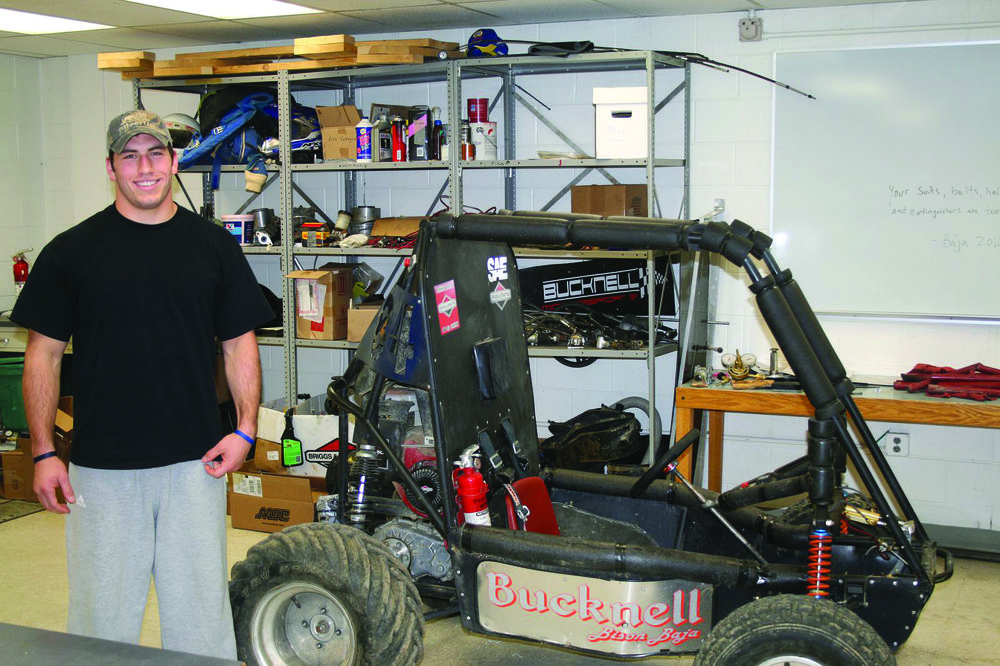
Travis Nissley ’11, mechanical engineer and middle linebacker, is the second student-athlete in Bison history to be nominated as a finalist for the Campbell Trophy, which is awarded to the most deserving student-athlete in the nation.

Nissley currently carries a 3.96 GPA in one of the University’s most academically challenging majors and is a standout on the football field. He is a team captain and fifth on the team for tackles this season.

For his achievement, Nissley received an $18,000 postgraduate scholarship from the National Football Foundation. He will find out whether or not he is the winner of the Campbell Trophy Dec. 7 at the awards dinner in New York City.

The Bucknellian: What, above all else, has allowed you to be one of the 16 finalists for the Campbell Trophy?

Travis Nissley: I think I would have to go with my grades. If you look at the evaluation criteria that they evaluate the award on, it’s a combination of your scholastic performance, your athletic ability, your athletic performance and your leadership and maybe a few other things. I really didn’t think that I stacked up well enough overall, but I guess my grades brought me through to get to be a finalist.

The Bucknellian: What aspects of this process are you most looking forward to? Anything you are worried about?

TN: I’m not worried, but I’m really looking forward to the trip to New York City. I’ve never been to New York City, except to play Fordham, and I guess that doesn’t really count because you don’t get to go anywhere but the hotel and the field. The only other guy to make it to be a finalist from Bucknell, David Berardinelli, he e-mailed me, congratulated me and said that the trip to New York was one of the best experiences of his life. It should be really cool—I get to meet all those people that I would consider to be in a whole different league athletically and football-wise.

The Bucknellian: What does being nominated for this honor mean to you?

TN: It means a lot. I’ve worked hard over the last couple of years, but I’ve been blessed intellectually, too. It’s a huge honor to represent the school. It’s like a football win almost: when you win, you’re glad you won for yourself, but the glory goes to the school and to everybody who helped contribute to that win. It speaks to all my professors, my coaches, my parents, my family and friends who have helped me over the years. It’s great to be able to represent all those people and all the things that went into it by being named a finalist.

The Bucknellian: How do you find time between playing football and being a mechanical engineer?

TN: I’ve been very fortunate to be gifted intellectually, so I can do well on tests and that stuff without studying too much. As far as the time management aspect of getting homework and projects done, you just have to be focused. It’s tough sometimes when your friends want to do something fun and you have to go get work done. It’s more about being able to sacrifice fun stuff for what you want later on down the road.

The Bucknellian: Has football ever affected your ability to perform in the classroom or vice-versa?

TN: Yes and no. It affects it, but at the same time, you can’t let it affect it. When we go on the field for football, we have a thought box and we symbolically toss our thoughts into the thought box. It’s meant to symbolize that when you go out to the practice field you have to clear your head of everything. So I can have a really long day, be all stressed out because of school, but I can’t let it affect me. If you want to be a good player, you can’t let the school aspect influence it, and it’s the same way for school. Sometimes I’ll roll into class feeling ridiculously tired or beat up, and all I want to do is sleep, but if you want to be good in school, you just can’t let it affect you.

The Bucknellian: What first inspired you to become an engineer?

TN: Well, I grew up on a farm, so I’ve always been around machinery and that kind of stuff. My dad was into snowmobiles, so I grew up around snowmobiles, dirt bikes, four-wheelers, that kind of stuff. That’s one of my biggest passions, I love that, engines and stuff like that. I didn’t really know what real engineering was all about until I got to Bucknell, but it’s verified my initial interest in things that engineering is relative to.

The Bucknellian: How have your team and your coaches helped you in your academic pursuits?

TN: They help to keep me focused. The group of guys I live with all try very hard in school and help to keep me focused. It’s easier to stay focused when the people around you are focused. Every coach that I have played under here always stresses the importance of academics and an academics-first mindset.

The Bucknellian: What do you value more, your achievements in the classroom or on the field?

TN: I would definitely say on the field. It doesn’t come nearly as easily on the field. I’ve been very fortunate to be gifted intellectually, and I don’t think I’ve been gifted like that athletically. Athletically, I’ve always had to work very hard to achieve any success that I wanted. When I achieve on the field, it’s definitely a greater feeling than in the classroom. That’s not to take away anything from the intellectual achievements, though.

The Bucknellian: What do you see yourself doing with the rest of your life? How are both your academic and athletic pursuits at the University going to help you with this?

TN: The time management and being able to sacrifice what you want at the moment for what you want overall is going to be huge in life. There are a lot of things in football: leadership experience and life experience about toughness and discipline that help in the workplace. There is obviously no direct correlation—you don’t need to be tough in the workplace—but the concepts transfer. Obviously I’ve received a great education here. You put all this time into the training of being an engineer here, learning everything, and you get to a point where you just want to get out and do something with it. I don’t know exactly where I see myself. I don’t want to get a job that drives me like a slave, but I definitely want a job that challenges me intellectually, somewhere that I could be a leader, as well. I want a job that combines both the technical side of things and also leading people, some type of team environment where we are striving towards something.
Categories
Arts & Life Movies Review

‘Repo! The Genetic Opera’ fails to be Halloween hit

By William Bonfigilo

Writer

It wouldn’t be Halloween season without terrible movies, often so campy and clichéd, horribly written and poorly acted that they are more titillating than terrifying. Once in a while, a movie will veer from beautiful teenagers being stalked by insane/misunderstood/evil forces and introduce a truly novel premise. Think “Saw” in 2004, before the torture porn genre became as outdated as last year’s jack-o-lanterns.

In 2008, film director Darren Lynn Bousman brought an original premise to the big screen. It’s a shame that the movie itself, “Repo! The Genetic Opera,” was so abominable.

“Repo! The Genetic Opera” was first conceived by Darren Smith and Terrance Zdunich as a stage play in 1996, but it developed a strong underground following, in no small part thanks to its creative take on repossessions.

The film’s introduction presents a bizarre futuristic world. The year is 2056, nearly three decades after an epidemic of mass organ failures devastated the world’s population. To combat the outbreak, a biotechnology company called GeneCo begins harvesting unaffected organs from the recently deceased, and leasing those organs to infected individuals. If patients are unable to pay their medical bill, GeneCo sends the Repo Man to reacquire the organ through any means necessary. Scenes of improvised surgery clog the movie, and, despite the American appetite for violence, the film drags.

“Repo!” embodies the very notion of campiness. Featuring a collection of performers who are either washed up (Sarah Brightman, Paul Sorvino) or lacking talent altogether (Alexa Vega, Paris Hilton), Bousman tries to make do with a style that is both grandiose and gross; organs are literally picked up and passed to the characters as if they were hot potatoes. Attempts at witticisms are crude and ineffective, characters are aggravating and whiny, and musical numbers are irritating, childish and poorly conceived, with too few strong moments for such a musically inclined cast (Brightman, Sorvino and Vega).

Such pretension shows a resemblance to the “Rocky Horror Picture Show,” another campy Halloween film that developed an underground cult following. The difference between the two films seems to be charm. While actor Tim Curry could make transvestitism delightful in “Rocky Horror,” Anthony Head, who plays the Repo Man, lacks the swagger to convey any emotion besides contempt effectively. His character grows tiresome quickly.

While the premise was strong enough to inspire an action-packed blockbuster (“Repo Men,” 2010), “Repo! The Genetic Opera” failed as a film, and while its style was certainly memorable, it was also really painful to sit through.