The University lost a powerful professor and figure in music on Sept. 13 to pancreatic cancer. William Duckworth, 69, was a pioneer in both postminimalist and Internet interactive music. Duckworth wrote about 200 compositions, working to fuse influences of bluegrass, medieval music, Satie, Messian and jazz. Also an author, known for his book of composer interviews, “Talking Music,” and a study of interactive music, “Virtual Music: How the Web Got Wired for Sound,” Duckworth proved multifaceted. Duckworth was a professor of music at the University for 38 years until taking a medical leave in 2011. Many national news organizations such as NPR have aired and published tributes to Duckworth. He is survived by his third wife Nora, his children, Will, Katherine and Alison and his eternal impact on the University and the world of music.
Month: September 2012
Christina Oddo
Arts & Life Editor
Students and faculty gathered in the lobby of the Weis Center for the Performing Arts on Sept. 12 to experience a Dena DeRose Trio performance. Molly Miller ’14 had the opportunity to perform with the Trio at the event. This jazz ensemble performance was part of the Janet Weis Cabaret Jazz Series.
“I met Dena DeRose in her studio apartment in Long Island City almost 10 years ago,” Miller said. “After which, Dena became–and continues to be–my greatest musical inspiration. I used to listen to her albums every night while I fell asleep, and I carry the lessons that I’ve learned from her with me always.”
DeRose has performed at many legendary venues, including the Jazz Standard in New York, the Kennedy Center in Washington D.C. and the Jazz Showcase in Chicago.
“Dena DeRose was incredible!” Katie Wimmer ’15 said. “Her voice was smooth and a pleasure to listen to. Some of my favorite parts were the solos of the base and drums. But my favorite part of the performance was Molly. She has an incredible voice which rivals the main performer. After going to this concert, I am now a fan of jazz.”
For Miller, this was an unforgettable experience.
“I have never had more fun performing than I had last Wednesday night, singing with the Dena DeRose Trio,” Miller said. “Matt Wilson is one of the most enthusiastic and dynamic people I’ve ever met. I love working with Martin Wind for his sensitive touch and creative intuition. And of course, there’s Dena. I am so grateful not only for the time spent with Dena, Matt and Martin, but also for the incredible opportunity to share some of my favorite music with my friends at Bucknell. The Janet Weis Cabaret Series gave me the chance to integrate my collegiate life into my life outside of Bucknell.”
Categories
Academic honesty should be valued
Josh Haywood
Senior Writer
In light of the ongoing investigation into the Harvard cheating scandal, and after reading several research articles by Donald L. McCabe detailing academic dishonesty, I believe the underlying cause of cheating is failure within two different peer groups: educators, who rely on illogical assignment structure, and students, who lack an honor system. According to McCabe’s 2005 research document on academic dishonesty, 21 percent (one in five) students reported cheating on a test at least once in the past year and 36 percent (one in three) students reported paraphrasing/copying material from an internet source (for written sources it was 38 percent) without citing it at least once in the past year. Overall, In his 1997 article, McCabe found that over students’ academic careers, 82 percent reported they had engaged in at least one serious form of cheating. It could be said these numbers are the result of professor academic mismanagement in placing too much emphasis on one or two assignments instead of spreading the load out equally through the semester. It could also be inferred that cheating is the result of an absence of an honor system among students; if nobody else says it is wrong for you to cheat, then is cheating really wrong at all?
Poor course structure can create an inclination for students to cheat as a means of academic survival. In McCabe’s 1995 article, two of the primary rationales for students to cheat were “I have too many competing demands on myself, so I have to cut some corners in order to survive” or “No one would ever know, so what does it matter?” Poor course structure comes in the form of too much emphasis being placed on group projects or only grading one or two assignments that essentially determine a student’s final grade for a semester. A professor needs to take a rational approach when developing a syllabus by taking into account student behavior, and not design an agenda that indirectly promotes academic dishonesty. High-stake educational models like the ones mentioned naturally breed academic dishonesty simply because there is too much to lose. If educational professionals were to adopt a more rational educational model where work is spread out, the propensity for students to cheat would be much lower because the tasks they are asked to do are within their means.
Student culture is also a major influence on cheating. For many students, a bit of cheating here and there is not considered to be that faux pas. Look at the rise of the modern day essay mill where students can pay someone else to write a paper on any topic for them. Things like this exemplify the lack of honor within student culture and could be a product of the tech boom over the past 20 years, which has made it easier for students to merely look up the answers to their assignments. It’s simple: students place a high value on time so why would they spend more of it researching a question when the answer is readily available online? Beliefs like, “no one would ever know, so what does it matter” drive students to act against their professors’ wishes. Even when students witness others cheating, there is often a hesitation to act because the witness can think of at least one time when they have been guilty of cheating themselves. This traps the student in a crisis of hypocrisy.
Cheating is just like nature: always in the constant state of evolution where the best methods to cheat will prosper. Educators need to combat this by taking a look at their agendas to see if it properly factors in student behavior, thus minimizing the possibility of cheating. Students need to learn to hold themselves accountable for their actions because if they get caught, they could be thrown out of school. It should always be known that the satisfaction of putting in the work and actually knowing material far outweighs that gained from cheating to get a passing grade.
*note, the answers to the questions that do not have name labels are what both of the presidents said through email, according to Anna.
Q&A with Her Campus co-presidents Liz Bacharach and Sarah Dubow
By Anna Jones
What is Her Campus?
“Her Campus (HC) is a national online magazine written by collegiettes (college women), for collegiettes. They have about 215 university chapters. At the national level, there are a variety of college student writers that write about everything from the newest styles to landing your dream job. On the university branch level, it is basically a girl’s guide to college. Coining the term ‘collegiettes,’ HC strives to guide college women through their college years.”
What differentiates HC from other social media websites?
“HC is all about empowering women to be … the best women they can be. We have fallen in love with HC because it is honest, quirky and unbelievably in harmony with what Bucknellians (and all collegiettes, for that matter) want to know. It hits every aspect not only of what it is like to be a woman–a collegiette–, but also a collegiette at Bucknell dealing with everything from how to find a formals date to training for a marathon to landing that dream internship.
HC fiercely protects its integrity, vibrancy and originality in a world of blogs that all begin to sound the same. HC Bucknell inspires through articles of real Bucknell collegiettes making an impact on our campus, in the country and abroad. It has its finger on the pulse of Bucknell collegiette life and is a resource we want to expand for all Bucknell women to have access to. With so many divisions at Bucknell between first-years and upper classmen, greek and non-greek, varsity athletes and non-athletes, etc., HC is a way to bring everyone together while still expressing individuality.”
Why do you think University students should read HC?
“HC is a great way to get a different take on what’s happening on campus from a woman’s perspective. From events to campus celebrities to the cutest guys (and girls!) on campus, the website serves as a source for procrastination, enlightenment and fun. We upload new content throughout the week (seven articles per week) so there is always a new article to be read, whether on the national level or Bucknell level.”
How did you get involved with HC?
Sarah: “I started reading it first semester last year and kind of fell in love with it. I went abroad last semester, but still wanted to write so I was their abroad correspondent. Then, the two girls who founded HC were graduating, so that’s how I came into the presidency position.”
Liz: “I want to focus on journalism, so I researched all the clubs at Bucknell that were involved with that. We’re not a University-supported club just yet though, so I found out through my friend who runs hers at Emory how to get involved and I figured out we have one here too.”
How can other University students get involved?
Sarah: “We switched over to an application process this summer, so we had people apply over the summer and then we have our full team–except for first-years–for the year.”
Liz: “We have a staff of about 20 writers so far, but we’re looking for first-years so we’re beginning that process in the next two weeks.”
Sarah: “But if people are interested, they can always just email us because there are always ways to get involved.”
What do you like about writing for the site?
Liz: “It’s hard not to love writing for it. It’s such a unique outlet for college girls … and it’s a very relatable source. It’s easy to connect to the readers.”
Sarah: “I think it’s also a very needed outlet, especially on our campus because sometimes I feel like the boys get more of a spotlight.”
Liz: “It’s also so much fun to write for.”
Sarah: “We have an amazing group of girls and they’re so well rounded, passionate and just amazing to work with.”
Where do you see HC going this year?
“We are so excited to be back for our second full year on campus. Our branch is truly expanding this year with new advertising, downtown giveaways, events and more. We want to not only create an online space from the women at Bucknell, but also bring it to life from the LC to the quad, downtown to taking over fraternity row. Keep your eyes out for all the exciting things we’re doing this semester and remember to like us on Facebook, follow us on Twitter and check us out online!”
Carolyn Williams
Writer
Jennifer Egan’s fifth book, “A Visit from the Goon Squad,” has been met with overwhelmingly popular and critical approval, earning it last year’s Pulitzer Prize for Fiction. Whether or not to call this work a novel or a collection of interrelated short stories is still up for debate among critics, but regardless of how she does it, Egan’s work here is engaging from start to finish.
Set largely in New York City, but also in a few different spots (California and Italy, to name a few), Egan relates a story of time and life set to the background of the music industry. Time is the eponymous “goon squad” as it shifts back and forth fluidly throughout the work, and it’s the story’s main impetus. Egan has said in interviews that her inspiration for the story was drawn from “The Sopranos” and Proust’s “In Search of Lost Time,” a bizarre combination that, weirdly enough, an informed reader can’t help but buy.
Summarizing is definitely difficult, as the 13 chapters can be read as individual works, set over 40 or so years. Characters move in and out of the work, sometimes playing leads, and other times unassuming supporting roles. Narrative privilege shifts, as does the style of writing. This is not a minimal change–we’re talking about first to second-person switches, a chapter communicated via PowerPoint slides and text-speak as a legitimate form of literature, perhaps suggesting this format as the new doublespeak (this particular chapter is set in an Orwellian New York future, after all).
We begin with the 30-something kleptomaniac Sasha who goes on a date with Alex. Alex later works for Bennie, who conveniently was Sasha’s former boss. Bennie himself was a shoddy bassist before getting into the music business and used to be married to Stephanie who works in PR. The connections go on and on. These are evolving and living characters, told sympathetically, but not to the point of sweetness; they’re trying, and sometimes failing, but that’s pretty typical, and Egan lets us choose whether or not they deserve the blame for their often laughably unexpected situations.
Egan’s greatest strength in “A Visit from the Goon Squad” is her ability to inject her delightfully barbed humor into her description and dialogue without seeming to try too hard. It’s sarcastic and modern, and, though it perhaps gets a little derailed towards the end, it keeps those pages irresistibly turning.
Paige Bailey
Writer
On Sept. 13, the University hosted a topping out ceremony for Academic West that focused on the school’s tradition of dedication to progress. President John Bravman highlighted this tradition of progress through a brief history of the University. He reminded the audience that years ago, a group of people decided to “build something special,” and that Academic West is just the newest addition to this rich legacy of achievement.
This was the first “topping out” ceremony in University history, and it commemorated the last beam that was placed in the new structure. Bravman first invited members of Bucknell Student Government (BSG) to sign the orange steel beam. He then encouraged the rest of the audience to share in the University history through signing the beam. Members of the faculty, staff, students and trustees eagerly signed the beam before it was placed at the top of Academic West.
“I think the new academic building signifies the commitment Bucknell is making to its students and faculty. Not being here to enjoy the building is a little sad, but seeing the direction the University is going is encouraging,” BSG President Dotun Odewale ’13 said.
“Working with the University was a once in a lifetime opportunity,” architect Alex Wing said. He also admired that the University was rooted in a precedent that is looking forward. Wing commended this commitment to both tradition and progress, in terms of architectural design features and the broader philosophical aims of the University.
Board of Trustees representative Ellen Bush ’79 also commented on how Academic West fits into the rich tradition and legacy of the University.
“This is not just a structure … this is a statement,” Bush said.
Bush believes the building is linked to the core mission of the University: to provide the best undergraduate experience in the nation. She said she was proud of the new project as both a trustee and alumna.
“The University is about people. But you can’t bring great people together to do great things unless you also have great places for them to work and build together. This is what we’re doing today. It is the legacy of the next, best version of Bucknell,” Bravman said.
Academic West is one building within the nexus of the new quad. It will be home to the social sciences, including the economics, environmental studies, geography, international relations, Latin American studies, political science, sociology and anthropology departments. The building will have an auditorium and hearth spaces for students overlooking the Susquehanna. It will be opened and dedicated in the fall of 2013.
Categories
Coasteering in Cymru
Rochelle Volmerding
Contributing Writer
I spent the fall of 2011 studying abroad at University College London in London, the United Kingdom, as a part of Arcadia University’s College of Global Studies program. Abby (a fellow UCL student from Brandeis University) and I decided to travel to Cymru, or Wales, as it is most commonly known here.
We took a train from London to Haverfordwest (Welsh: Hwlffordd), which is in a southern Welsh county called Pembrokeshire, home to the UK’s only coastal national park. After thankfully not getting run over by Welsh people in cars driving through roundabouts, we caught a bus from Haverfordwest to St David’s (Tyddewi). It actually is the smallest official city in the UK, and is the site of the final resting place of Saint David, the patron saint of Wales.
The next day, we decided to go on an early morning hike along the coastal path. The coastline was breathtaking. Since we were in a national park, it was virtually untouched, dotted only by the occasional Welsh farmhouse. There was something magical in this place, and I can’t exactly place it. I’m not sure if it was from the windy cliffs with the soft, lush green grass, the wind-eroded rocks scattered along the land or the wild Welsh ponies that were literally right in front of us.
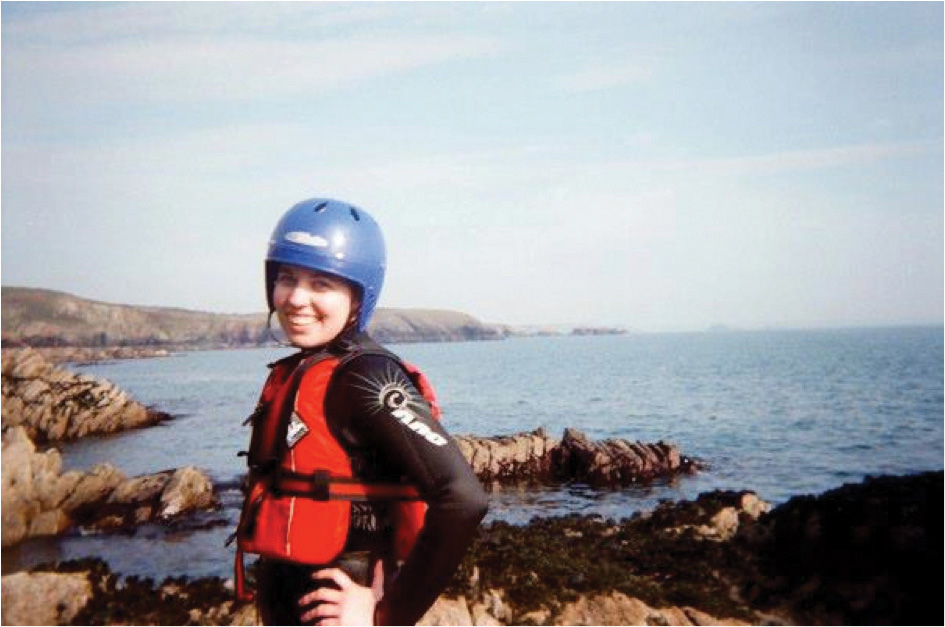
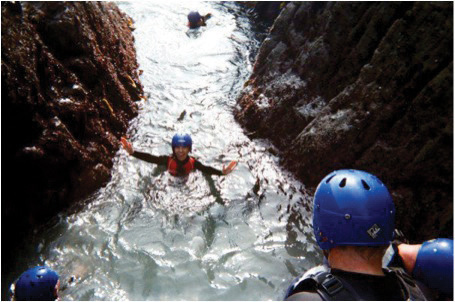
After lunch, we went coasteering, which is a combination of rock climbing, swimming, diving and pure adrenaline. It was pioneered right here in Wales over 25 years ago.
I have a fear of heights, but I felt safe going with our trained coasteering guide, Jon, who knew the safe places to dive into the water, as well as where we would not be disturbing the wildlife. After climbing down the rocks near the water, our first task was to jump down nearly three meters into the cool Atlantic. I gingerly gathered my courage and jumped. The feeling of the water rushing around me was refreshing and exhilarating. Jon told us the first jump was always the hardest. We then jumped and swam into a little inlet Jon called “the Toilet,” where the little channel caused the water to rise and fall by about five meters, making me feel as though we were in a whirlpool. Being (safely!) at the mercy of the waves was quite an unusual experience, but it was probably the most fun I’ve ever had in my life.
What I found the most fascinating about coasteering was how up close and personal I could to get with a marine ecosystem. We used the kelp that was attached to the rock walls to pull ourselves up onto the dry rocks, and it was amazing to see how strongly the kelp was attached. We used the barnacles on the dry rocks as grips to prevent ourselves from falling into the surf. We also swam inside of a cave, where the waves carved out a cathedral of rock from the inside.
Before we took the train back to London, we explored St Davids a little more, and went to the church service at the local cathedral. It was nice to visit the church and experience it for the purpose it was built for: worship. Interestingly, Her Majesty Queen Elizabeth II is actually a member of the congregation there.
After having proper English (or I guess Welsh) tea and Welsh Cakes (which were sweet pancake-shaped biscuits), we caught the bus back to the train station for a long ride back to London.
Categories
Sonnenblick encourages writers
Jen Lassen
News Editor
A Teach for America educator-turned-author offered his story about how writing slowly crept into–and later took over–his life.
Jordan Sonnenblick, author of the best-selling book “Drums, Girls, & Dangerous Pie,” discussed his motivation for becoming an author on Sept. 19 in the Gallery Theatre.
“I tried to find the kid who needed a book in his or her hand that didn’t exist. Every book I’ve written has been that: some way I could hand a kid that book,” Sonnenblick said.
Sonnenblick’s first book was inspired by Emily, one of his eighth-grade English students, who disguised her sorrow over her brother’s cancer diagnosis by giggling her way through every class. He credits teaching as an experience that helped him understand kids and how to write.
“Teaching both as an English teacher and through the Teach for America program led me to have a tremendous compassion for kids. It also made me understand the dynamic of family more. Through teaching I experienced humility from seeing how wrong about a certain kid I was,” Sonnenblick said.
These humbling experiences led Sonnenblick to write not one, but eight novels about kids and teenagers. His writing process for these novels is unlike other authors.
“There’s an element of randomness in my thought process … I write at weird, inopportune times; I’m the least disciplined writer in America,” Sonnenblick said. “If I don’t write 1,000 words in a day, I’m dissatisfied.”
He also discussed how having a plan will not always lead you the right way.
“Even though you think you have a road map, you find out stuff through character interaction while writing,” Sonnenblick said.
Sonnenblick credits his high school creative writing teacher and Pulitzer Prize winner Frank McCourt for kindling his interest in authorship.
However, Sonnenblick’s interest didn’t exactly start there. He spoke of a childhood friend named BJ that asked Sonnenblick at age three what he wanted to be when he grew up, to which Sonnenblick responded that he wanted to write a book.
“At first, I felt elated and horrified about becoming a professional writer. I feared that the next idea wouldn’t come,” Sonnenblick said.
When “Drums, Girls, & Dangerous Pie” was published, Emily’s mother called Sonnenblick to give him her thoughts on his book.
“She called me and told me ‘you got it right.’ That’s when I found my purpose in life,” Sonnenblick said.
A big part of Sonnenblick’s authorship is utilizing humor in his books, and his sense of humor was evident throughout the speech.
“My wife has to talk to me like I’m a brain-damaged toddler the week after I write a book; she even stoops down a little bit to get my attention,” Sonnenblick said.
“Sonnenblick’s speech was interesting. He’s very personal, which I liked. I’m interested in reading his other books,” Morgan Houchins ’16 said.
Whether you plan on teaching or curing cancer, Sonnenblick’s advice is gold: be ready, because you never know where the path may lead you.
Molly Ford
A group of University students will perform the complete works of William Shakepeare in an unpredictable and hilarious single two-act and one hour-long production. “The Complete Works of William Shakespeare (abridged),” directed by Adam Wennick ’13, will be this weekend, Sept. 22 and 23 at 8 p.m. This student-run performance is modeled after the work of a three-man comedy group, The Reduced Shakespeare Company.
Wennick, along with 10 actors, a lighting designer, a stage manager, two assistant stage managers, a props master and a lighting operator will take on the lofty challenge of putting a modern spin on Shakespeare’s classic works by combining Shakespearean and contemporary language and themes.
After a witty introduction, the actors portray the beloved “Romeo and Juliet” and immediately follow up with the less successful “Titus Andronicus” in the form of a cooking show. Wennick did not want to give too much away when asked about the performance.
“We lovingly parody all of [Shakespeare’s] works,” Wennick said. “I have been picking apart the script and loving it for the past year.”
Wennick’s inspiration came from taking Assistant Professor of Theatre and Dance Anjalee Hutchinson’s directing class. After the Theatre and Dance department decided to do the mainstage of “Macbeth,” Wennick thought it would be a good idea to do a whole Shakespeare season.
“I had trouble deciding exactly which show I wanted to do, so I thought, why not do them all?” Wennick said.
Wennick wants the audience to laugh harder than they ever have at a University performance. He is most excited for the second act and the audience’s reactions.
Tickets are $5 and can be purchased at the box office.
Categories
Fall Fest Recap
Gloriana on stage at Fall Fest.
Caroline Schaeffer
Writer
On Sept. 15, Campus Activities & Programs (CAP) hosted a school-wide “countrified” Fall Fest on the Sojka Lawn, featuring performances by Tyler Hilton, Gloriana and Jack Ingram. Fall Fest was held from 1 to 6 p.m. and included a variety of different events, such as old time photos, a ferris wheel, a mechanical bull and an obstacle course. A southern dinner with mac ‘n cheese and sloppy joes was also included.
“Fall Fest is a really nice opportunity for the whole school to bond as a community with cool and fun activities offered that students can actually enjoy, and some good food,” Amelia Romero ’16 said.
It was cloudy and breezy when the crowds started to gather at the festival around 1:30 p.m., and many were wearing their most “countrified” cowboy boots, jeans and plaid shirts. Musical entertainment was provided by student band “Colin and the Hassels,” who performed popular country songs like “Wagon Wheel” and “Shake It For Me” for the early crowd.
Booths were set up all around the lawn, and students had a variety of different options when it came to entertainment. The mechanical bull and “Rattlesnake Run” obstacle course provided more physical forms of entertainment for students, while the old time photos, bracelet-making station and tie-dyeing station offered students a creative and fun way to bring home a souvenir from the festival.
The sun came out around the same time as the day’s first performer, Tyler Hilton. Hilton, 28, who is known for his role as Chris Keller on “One Tree Hill,” engaged the crowd in some playful banter and performed many of his most popular songs, including “Jenny Turn Around” and “Prince of Nothing Charming.” Hilton concluded his performance around 3:15 p.m., but stuck around afterwards to take photos with fans.
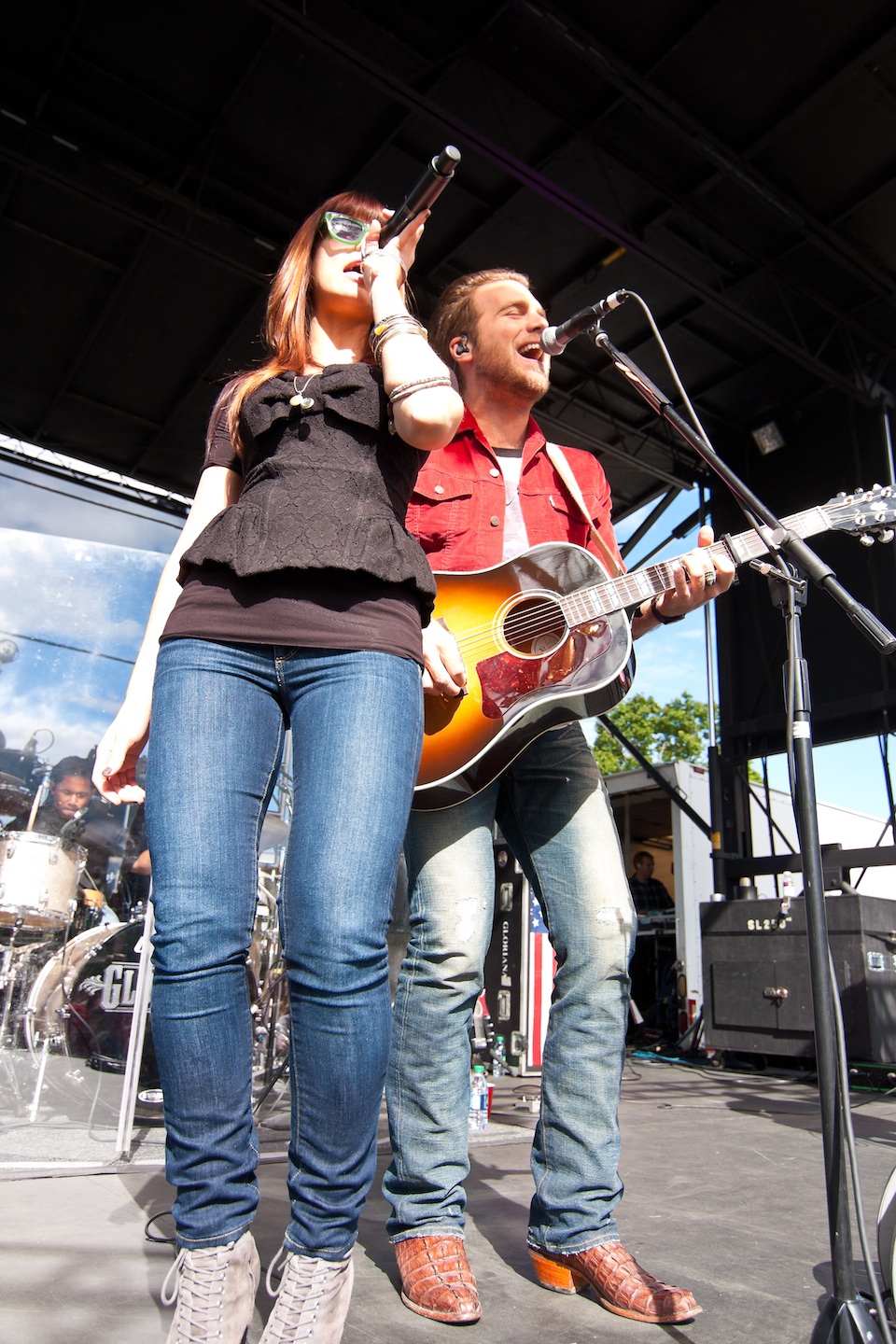
A large crowd began to gather around the stage at about 3:30 p.m., when Gloriana, a country music group from Tennessee, was set to perform. They opened with one of their main hits, “Wild at Heart.” The lead singer Rachel Reinert, encouraged cheering from the crowd throughout the band’s performance. They ended with their highest charting single “Kissed You Goodnight,” which has now sold over 800,000 copies.
A lot of students seemed to enjoy this year’s change in music for Fall Fest.
“I like the choice of country music for the festival’s theme. It was a fun idea,” Xander Vining ’14 said.
The festival began to wind down around 5 p.m. when country rock singer Jack Ingram performed to finish the day off. Ingram performed a number of upbeat country rock songs for the crowd. During his performance, students lounged on the grass and enjoyed the day’s weather with friends. The festival ended at 6 p.m., and with the kickoff of fall already under their belts, students were ready to return to their daily lives, perhaps a little more countrified than they had been before.