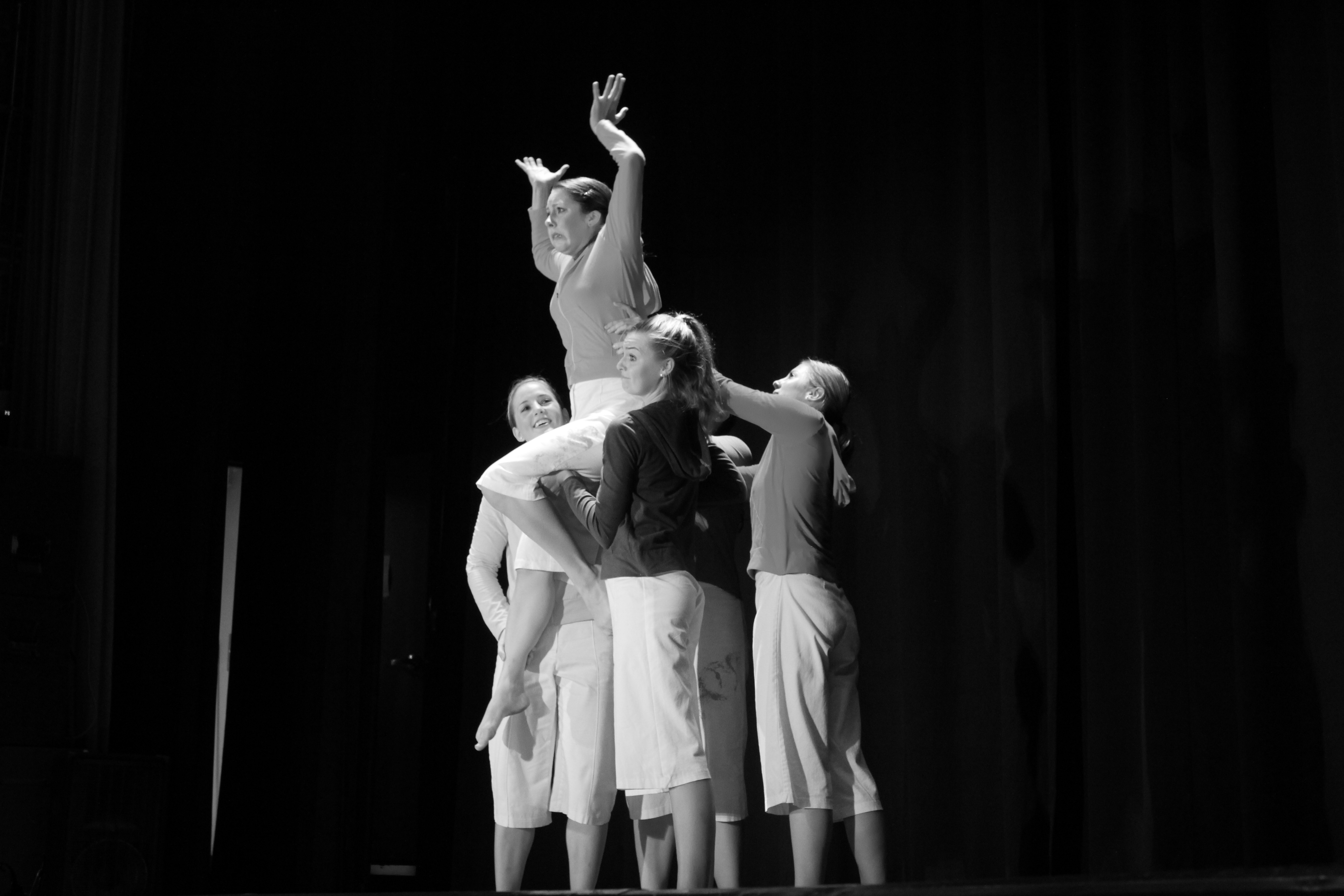
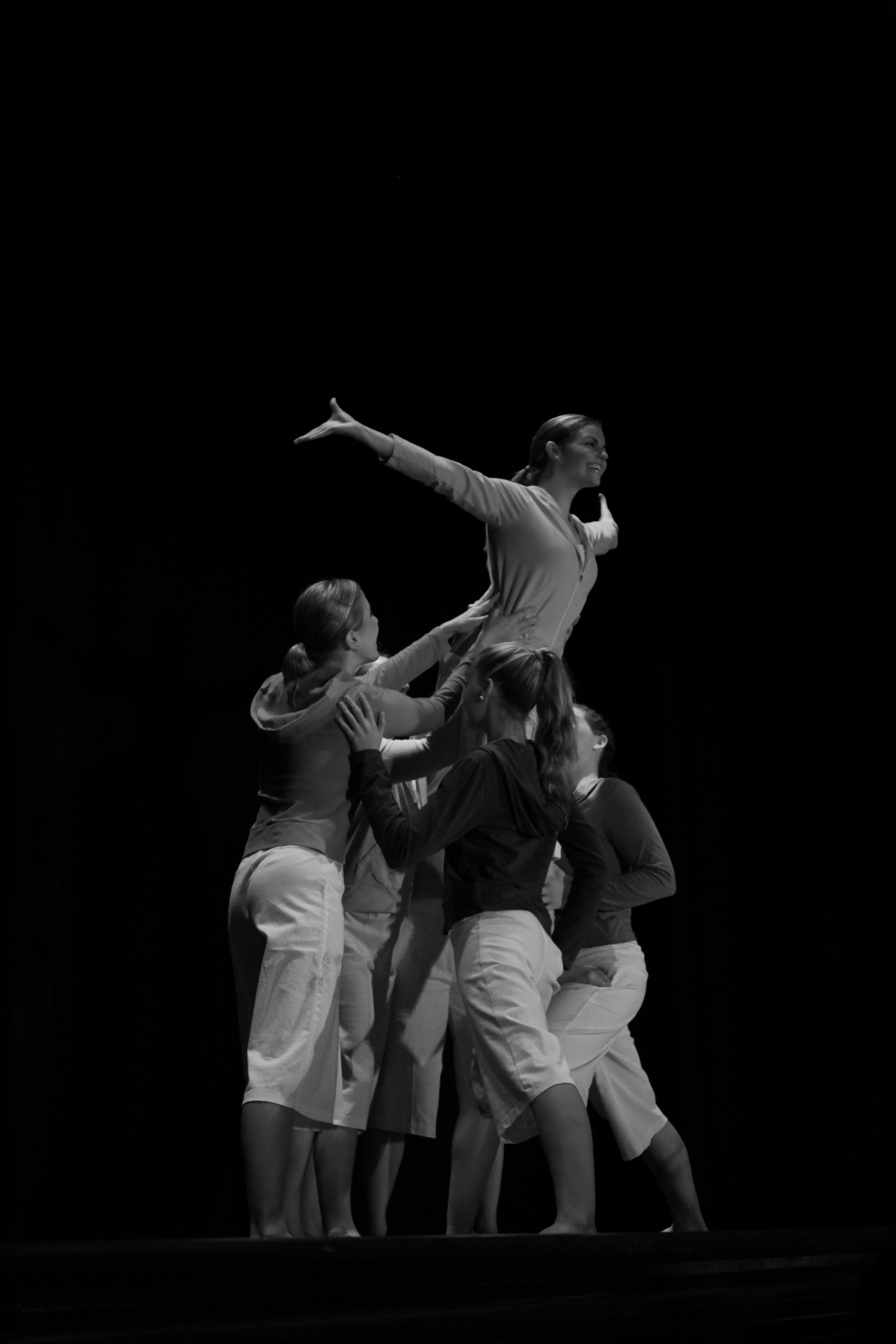
Local song-artist Billy Kelly and the Blahblahblahs, accompanied by six Bucknell Dance Company members, performed in “The Happy Happy Song and Dance Show,” a children’s performance. This debut event occurred Sept. 10 at 3 p.m. The performance included 10 dance pieces, one of which was performed by children from the local area.
“I thought the kids were really into it and they got everyone, even Bucknell students and parents, to dance with them,” Kelsey Fletcher ’14 said.
“I went to the show to support my friends and the dance program and I ended up having just as much fun as the kids! It was very funny and entertaining, and I had a great time,” Jackie D’Aquila ’14 said.
Tickets were $10 for adults and $5 for children, with a $15 family rate.
Madison Lane | The Bucknellian Melissa Dunne ’15 gets hoisted in the air by her fellow dancers. The performance included nine dance pieces by students.
I was seriously disturbed after seeing the somewhat recent movie “Chernobyl Diaries,” or rather, the trailer (I’m sure you don’t walk away with much more after seeing the whole thing). It wasn’t the mutated goblin-people that got to me, nor was it the blood and gore. Instead, what truly scared me was the realization that people have a strange fixation, no, obsession with death. This morose obsession does not revolve around the consistent, inescapable encroachment of death; rather, it is fueled by our sick desire to not only see, but also comprehend all of the horrendous ways a human body can be destroyed. The simple Braveheart-esque sword plunge has lost its entertainment factor and now is being replaced by things like putting someone’s limbs in an automatic pencil sharpener, fueled by an electric current from a 1987 Honda battery into his unsuspecting nipples.
According to Spike TV’s last chance at any sort of ratings, there are “1000 Ways to Die.” Why do we need to know all the obscure ways that our heads can possibly be smashed? It’s because we are constantly undergoing a kind of desensitization. Remember “ER?” The show ran from 1994-2009, making it a program that effectively spanned the equivalent of a millennium in the special effects galaxy. Even when blood looked like nothing more than barbeque sauce, in the early 90s, people grimaced and cringed. Even a few years ago, during the Mel Gibson “sugar-tits” era, “The Passion of the Christ” was thought to be the most graphic thing on the big screen. Since then, we have greatly surpassed anything that was thought up by “Mad Max.”
What happened? Why do we need to see horrible things happen to unsuspecting, innocent people? In these movies, the person who usually gets caught in a paper shredder isn’t even a bad individual. We’ve moved passed karma and have become fans of indiscriminate robo-shark attacks.
I’ll tell you what happened. We are bored. As people, we’ve become so accustomed to immediate gratification that we no longer care about what happens between the start of the movie and when the characters are killed off. We’ve written off all engagement in plot, and all we want to see is when the mutant bats eat someone’s eyes out. The best proof of this transformation I can give is this: when any group of people get together to watch the Oscars, absolutely nobody there has seen even half of the nominated films. I don’t just mean the obscure silent ones from New Guinea, but even the pictures that have a good deal of cinematic quality were unseen, which apparently nobody wanted to because it was over two hours long and didn’t show Channing Tatum’s testicles in 3D.
I don’t mean to accuse these low budget films of being total wastes of space and time, but please do yourselves and the greater American populace a favor: one time this year, just once, go and see a quality movie with a deep plot line. You’ll feel good about yourself and maybe, just maybe, you’ll enjoy a movie without a disemboweling scene.
It seems that communication through text, e-mail, Twitter, Facebook and online chat has taken over our culture and become the primary mode of communication, decreasing face-to-face conversation. People seem to be interacting more via keyboard via speech. While it may be easier to send a Facebook message than to interact with someone in person, it’s dehumanizing. We are social beings, meant to share information and emotions through tone, hand gestures and facial expressions. Instead, we are limiting our correspondences to messages flying through the air and landing on someone’s computer screen or phone.
Yet, it is important to note that the technology we have provides wonderful tools that have made things we never dreamt of possible. We can now reach loved ones and friends that live thousands of miles away with a simple click and can share pictures, videos and audio with them. The problem is not the technology, but instead, how we use it. These tools are meant to enrich relationships, be they familial, friendly or romantic, but are horrible for creating these bonds. True friendships and romances are based around shared experiences and personable encounters, two things that cannot be duplicated on the Internet.
We have been using such resources as a crutch, instead of the pillows they were meant to be, because they’re easier. Take the example of asking someone out on a date. You have to walk up to them, with a big ball of anxiousness building up in your stomach, and then look them in the eye and blurt out the question, all the while wondering how they are going to react.
It’s miserable, and it’s a huge load off one’s mind to simply send a message across some sort of medium asking the same question. However, the personal encounter is so much more memorable than a simple text message. If you go up to someone and ask them out, it’s a unforgettable experience for them and they are probably going to respond positively to it. A message, on the other hand, is easily dismissed as unimportant and probably will be deleted by the receiver. Although media is more convenient, verbal contact is much more rewarding.
With all the technology available to us, we have increased the number of acquaintances we have, but decreased the number of meaningful relationships. We need to stop relying on instant messages and chat rooms to talk with people. There is no alternative to meeting them in person and sharing experiences with them. We need to start communicating like humans again and not like machines shooting text and information into the world and hoping someone reads it.
“Work hard, party hard” is the perfect motto for the campus community. It’s important to remember that the University was not only rated the 29th best National Liberal Arts College, but also the 7th best party school this past year. On weeknights, students buckle down and tackle hours of homework, but every Friday, Saturday and oddly enough, Wednesday, students dance and drink their worries away, often haphazardly. In an environment such as Lewisburg with not much to do, drinking becomes the go-to way to ensure a “good time,” or in the very least, ensure that something “interesting” happens in the minds of many students.
Personally, I find it almost impossible to escape the heavy drinking culture on campus. There is always some kind of drama associated with party-goers, whether it is that one friend who had too much to drink and needs to be taken care of or being woken up by the influx of drunken party-goers returning from their respective nights out.
Here, drinking is never just a chill night with your friends, and the extent to which students party is dangerous and definitely overwhelming. The heavy drinking culture creates a domino effect on social life and your party habits essentially decide who your friends are.
Now, while it is expected that others will drink in college, I believe the University’s party culture takes “the college experience” a step too far. It is not uncommon for Public Safety to have to be called on weekends here or to hook up with a total stranger and forget it ever happened. Some students would argue that these occurrences are all part of having a good time and as long as no one gets seriously injured, there is nothing to worry about.
But I ask you, where is the line? When do you realize your limits and take into account the long-term effects of your actions on your academic/social standing? Only time will reveal the answers to these questions, and as our four years at this University go on, each answer will be different for everyone.
My best is advice is to avoid doing things you are not comfortable with and take care of yourself. Trust me, you can have fun and go out without a trip to the emergency room, and staying safe will ensure many more fun nights to come.
The Great Flood of 2011 may be nearing its first anniversary, but the effects of it are still around, creating a psychological divide between the upperclassmen students, this year’s first-years and all incoming classes from now on.
For those innocent first-years reading this, allow me to explain. Last year, when Hurricane Irene rolled by, it rained hard enough that the soil ended up saturated with rain water. This wouldn’t have been a problem, except a few days later, Tropical Storm Lee arrived. Because the rain had nowhere to go, it stuck around. As the rain poured, the water continued to rise. Eventually, local businesses had to close, professors found themselves unable to drive to the University and students living downhill had to evacuate to dorms on higher ground.
For most of us, it wasn’t too horrible. Classes got cancelled, we made new friends (I met one of my best friends here because he needed a place to camp and chose my hall’s common room) and we even got some cool shirts out of it. However, others were not so lucky. Zelda’s Cafe was shut down for months and many other local businesses suffered because of the catastrophe.
We now have a first-year class that has never seen 7th Street become a river, had to sleep in the field house or had the experience of getting drunk on a raft in the Smith parking lot and declaring it a pirate ship, as a few enterprising individuals did. They don’t carry the psychological scars that we do. They will never look up at an overcast sky and feel that same mix of fear, hope and nostalgia that deep down we all experience when we gaze at rain clouds. For them, the idea of a day off from classes is a quaint idea, not a harrowing experience.
This is not something we tend to think about too much, but it is still important to acknowledge. It is impossible to deny that there is now a lasting divide between the first-years and everyone else (and especially the current sophomores). Last year was my first year, and I can’t help but realize that when I’m a senior, my class will be the only ones to remember the Great Flood of 2011. That stuns me.
For the class of 2015, the flood was both an incredible bonding experience and a metaphor for how our lives are going to be: unpredictable and dramatic. It is events like these that shape us into extraordinary people. We are defined by it, more than any other class, because it happened so early in our college experience, before we had even really settled in. We will always be children of the flood.
The “freshman 15.” You’ve undoubtedly heard this phrase uttered in your presence at least a few times during your preparation for college, to which you probably responded with grim thoughts of your favorite clothes splitting at the seams. To be clear, the “freshman 15” is defined as the extra poundage–usually about 15 pounds–you gain during your first year of college. The main culprits of this phenomenon tend to be food, alcohol and lack of time or determination to exercise. Before you give in to the temptations of college life, take a minute to read my advice: control your cafeteria cravings, indulge a few nights a week and make an exercise schedule.
You are what you eat. The most important part of avoiding the “freshman 15” is to eat well whenever possible. Unlimited swipes to the cafeteria are certainly a dangerous situation. Portion control coupled with a sharp eye for a nutritionally balanced meal will be your key to success. One plateful of food plus a side of salad or fruit should be your goal.
As for the content of that plateful, aim to stay away from pastas and pizza and gravitate towards stations like Mongo Bongo and the egg bar. Furthermore, and perhaps most importantly, avoid sugary drinks and sodas. Drinking plenty of water will not only help with maintaining your weight but also keep you feeling well.
The key to having this will power to eat in moderation is to allow yourself one day a week when you are allowed to eat whatever your heart desires. The logic behind this practice is that you will get whatever junk cravings you have out of your system and be ready to resume your ambitions of living a healthy lifestyle the next day.
The consumption of alcohol is another indulgence that, if you choose to participate in it, should be moderated. Two nights of responsible drinking a week should be your absolute limit. Again, make sure you are drinking enough water, especially the night after an alcoholic adventure.
Finally, get your body moving. The contemporary belief regarding exercise seems to be that the more you get, the better. Unfortunately, we waste their time with extra gym sessions that provide us with little to no benefit. My suggestion is to get rigorous exercise three to four times per week.
Don’t just go to the gym to coast on the bike or ride the elliptical–push yourself! A few intense workouts a week are better than a week-full of mediocre sessions. Determine your exercise plan for the week before it starts and make sure you will be able to follow through. The hardest part is getting out of your room.
Implementing a solution is never as easy as reading and understanding one. You will struggle and you will want to submit to your lazy inclinations. However, once you get into the habit of a health-conscious lifestyle, you will find it easier to uphold your newfound routine.
Now that we’ve had some time to adapt to our new roles, brothers and sisters, perhaps we should be asking ourselves whether rush actually works. While many of my compatriots are delighted with how all the proceedings have turned out, some have discovered they don’t feel quite so fuzzy about their new brothers and sisters and are already considering a quiet withdrawal. Because the overwhelming majority of people are immensely happy with where they ended up, I would argue that the process works.
For men looking to join a fraternity, the process is rather simple. You visit all the fraternities, and after a ton of free food and all the “bro-flirting” you can handle, you pick your top three you’d like to eat meals with. The fraternities also pick who they’d like back. The requests are matched up, and you eat lunch and dinner at the fraternities that you got meal bids from for the next three days. After that, you pick your top two fraternities, they vote on whom they would like to give bids to, and as long as everything matches up, you say hello to your new brothers!
I’ll admit, most of what I know about sorority rush stems from the article Siobhan Murray ’15 wrote last week on how the suspension of Pi Beta Phi sorority affected recruitment. That said, I will do my best to give a brief summary. It seems mostly the same as fraternity rush, except instead of doing it on your own, you do it in groups (for reasons never explained to me) led by a “neutral recruitment counselor,” and you apparently do a lot of singing.
After this, a mutual selection process whittles down the number of girls visiting each sorority until the girls pick their top two sororities, and the sororities pick to whom they’d like to offer bids. An interesting quirk of this is that while the guys get their official bids on Thursday, the girls have to wait until Friday to find out where they ended up.
Additional differences are present as well. Sorority rush apparently has taboo topics, set times when you can go to the bathroom and is generally considered to be far more stressful. Fraternity rush has far fewer guidelines and actually involves going to houses. The food, despite being free, is excellent. I had dishes like steak, lobster and ribs (although sadly not all at the same time).
Now, the big question is, does the process work? I would say it does. While I know some people that aren’t too happy about where they ended up, those are in the minority. For men, 226 were placed in fraternities (as of this writing, the official numbers for sororities have not been released). The overwhelming majority of people are immensely happy with where they ended up. That tells me the process works. It may not be perfect, but I highly doubt any process would be. Roughly half the campus is Greek, and you’d be hard-pressed to find someone who isn’t happy after having rushed. Rush works.
When you’re on campus buried in schoolwork and activities, it may seem impossible to find happiness. You may question your abilities, lust after clothes you can’t afford or despair over your appearance. We want happiness and sit still until it comes knocking on our doors. But, we can only become happy by actively searching for it.
First, be happy where you are. You can spend every second of your life wishing you were vacationing in Bora Bora or that you were a billionaire, but instead, you should make the most of what you have. You may be hundreds of miles away from home, but you can still be content with your surroundings and find happiness where it’s hidden. Watching a good movie, eating a nice meal or hanging out with interesting people can all make you happy. Even having peaceful solitude can make you happy. The key is a positive mentality.
Learning to love yourself can also make you happy. I’ve spent my formative years comparing myself to others largely because of my parents. They constantly nagged me about my weight, laziness and mediocre grades. It used to make me doubt myself, and I would always assume other people were better than me.
If you place unreasonable expectations on yourself, you will end up insecure and miserable. Everyone has a different skill set and some people are better in other areas than you, but you are also better at other things, too. You can’t take everything too seriously and must instead learn to appreciate your own talents.
Own up to your mistakes and take responsibility. You may be anxious over a bad grade, an argument with a friend or a mistake you made at work. Instead of moping about it, learn from it, apologize and move on. Dwelling on things only makes you more miserable. Dealing with your problems immediately and not blaming yourself clears your conscience.
Take some risks. Much like Jim Carey’s movie “Yes Man,” you have to say yes to the opportunities given to you. It can be small like a cup of coffee with a friend you don’t know so well or something bigger like trying out for a theater production.
By sampling different things, you can find your interest. The University offers a multitude of activities like zip-lining or food sampling. There’s something out there for you. Opportunities, like people, will not always appear automatically. You have to seek them out.
Lastly, maintain balance. We are allowed to determine how we spend our time: with friends, school, sleeping or having fun. Do no overload on one thing. Like William Ernest Henley said in “Invictus,” “I am the master of my fate.”
We are the ones in control of our lives, and you can’t blame externalities for your problems. Everyone is allowed to be happy, but only if we allow ourselves.
Media is a force not limited to words in a newspaper or images on a screen. It has the ability to pervade across cultures and backgrounds, portraying people differently than who they actually are and what they truly stand for. Knowing this, Dr. Isabel Molina-Guzman has uncovered the secrets of mass media and how different forms of media skew our perceptions of Latinos.
Molina-Guzman, a nationally recognized critic of Latinos in the media and author of the best-selling book “Dangerous Curves: Latina Bodies in the Media,” gave a speech in the Traditional Reading Room of the Ellen Clarke Bertrand Library on Sept. 10 at 6 p.m. Her talk, entitled “Performing Latina Racial Flexibility in the ‘Post’ Media World,” focused on the portrayal of Latin American persons in the media through images, television shows, interviews and online content. She also focused on how these various mediums collectively paint inaccurate pictures of Latinos in a “post” world, one supposedly looking past racial differences and becoming more progressive as a population.
“We’re being told by politicians in media that race, gender, ethnicity and sexuality don’t matter or shouldn’t play a role in our policies. Reality is, we’re living in a United States that is increasingly diverse,” Molina-Guzman said.
Molina-Guzman pointed out how in the United States alone, Hispanic student enrollment has increased year after year. Connecting this to her points about globalization taking force in the United States, Molina-Guzman’s passion lies in critically analyzing values our culture assigns to ethnic and racial minorities.
“Media functions as a normalizing institution. This means that the media reinforces dominant normatives,” Molina-Guzman said.
Basing her presentation off of these “normatives” about Latinos already present in the United States and the stereotypes possibly associated with these people and/or their culture, Molina-Guzman focused on three case studies of Latina women to enforce her argument. These women included actress Sofia Vergara, singer and actress Jennifer Lopez and model and actress Zoe Saldana.
Molina-Guzman focused on how each woman was pressured to conform in different ways to the American normative for Latina women. For example, she highlighted how the pressures on reality television show “Modern Family” forced Vergara into the normative of a Latina “spitfire,” how relationships with white and black celebrities made Jennifer Lopez conform to different Latina racial connotations and how Saldana’s blackness as a Latina pressured her to fit into–and become defined by–a unique group of Hispanic women.
Her three case studies proved her point that media also constantly feels pressure to conform to a certain standard of normatives present in a country.
“Media is under a constant pressure to conform to the same model,” Molina-Guzman said.
Molina-Guzman also pointed out how there has been a significant increase in Latino actors in media overall. She also makes the point how the demand for these professionals has caused most of them to compromise their cultures for profitable gain.
“Media consumption is more partisan than ever before. This highly selective media consumption influences how we see the world,” Molina-Guzman said.
Students had differing reactions to Molina-Guzman’s speech.
“I disagreed with most of what [Molina-Guzman] talked about. We also need to consider other things like the creative team for a celebrity’s image versus just looking at the artist themselves,” Kiara Huertas ’14 said.
“I liked that Bucknell brought a speaker to talk about Latino culture and social problems. I thought that was very important,” Angel Hernandez ’13 said.
Molina-Guzman concluded by discussing how media portrayal of Latinos leaves us blind to how we should view the reality behind these cultures.
“The poverty levels [of Latino culture] in the United States are striking, and the reality of it all is hard to avoid,” Molina-Guzman said.
If there is one thing to take away from Molina-Guzman’s talk, it is that media has the striking power to distort and deceive.
“I argue that post-media and post-gender and post-ethnic notions matter in our ‘post-race,’ progressive world than ever before,” Molina-Guzman said.
Associate Professor of Education Sue Ellen is an anomaly: she not only works inside the classroom, but outside as well, making her love of education known with everything she does.
Henry plays a number of roles at the University. This is her first faculty teaching position; however, she did a little teaching as a graduate student at the University of Virginia. Here on campus, she is a senior fellow of the Social Justice Residential College and takes care of tenure for staff members.
She has been at the University for 16 years and she says she’s stayed so long because of the people and the potential that people have on this campus.
“I experience this place as a place that wants to be better. I appreciate working with colleagues who are dedicated to good thinking, relevant thinking and enduring thinking,” Henry said.
Henry sees many places at the University where students can make an impact, and she appreciates that.
“I enjoy having really good conversations about a social institution that is so central to our society,” Henry said.
Her view regarding the importance of education classes shows how dedicated she is to professing the value of this privilege.
“In the United States, we don’t all share the same language or the same religion; we don’t all eat the same food or watch the same TV shows. The two things I can say with relative certainty that you’ve experienced, if you grew up in the United States, are going to the mall and public schools,” Henry said.
She feels strongly that the public education system is a central institution of our society that connects people, relating to her role as a Senior Fellow of the Social Justice Residential College.
“Once you’re done with your education in the public schools, you can’t avoid people who have been educated by the public schools,” said Henry.
Henry also discussed the importance of majoring in education and its impact on the people who study the system.
“There are two kinds of education majors: those who have known that they want to be teachers since third grade–and that’s lovely–and those who wish to get involved with education at a different level. The first kind of people see a connection between schooling and society and want to be integrally involved. The other type can get a B.A. and work on education from a policy-making level, a guidance level, a higher education level or a children’s publishing or advocacy level. We still have an opportunity to reach education majors at a lot of different levels,” Henry said.
In addition to her main role as a professor, Henry has been on the University Review Committee for three years, and this year, she’s the co-chair. This committee is a group of elected faculty and administration that conducts university-level reviews for retention, tenure and promotion of the University’s faculty.
“I believe it is an important function of the University to review faculty and make recommendations to the president and Board of Trustees about something as important as tenure. Tenure is important because it makes sure faculty remain active and free and are available to do the critical thinking that we need in this age,” Henry said.