Categories
Arts & Life Campus Events Review

ACE presents a night of Mexican food and activities

Anna Jones
Writer

After several weeks of intensive planning and advertising by the Spades Committee of Activities and Campus Events (ACE), headed by Asha Harvey ’15, the committee pulled off a successful Fiesta Night in the Terrace Room on Oct. 19.

Upon walking into the room, guests were overwhelmed by the sound of festive music and the enticing smells of Mexican food, including make-your-own tacos and burritos. On the other side of the room, there was a long table filled with bowls of chips and just about every kind of salsa possible, ranging from extremely spicy to more mild. If your taste buds needed something to cool down, virgin margaritas were being served in the middle of the room. In another corner sat cinnamon covered churros with vats of chocolate for dipping. People raved about the food, which was prepared by the University’s dining staff. 

One of the main events of the night was the hot pepper eating contest.

“[It] was a huge attraction for many attendees,” Harvey said.

Harvey said they wanted to “facilitate friendly competition,” and that the committee is working to make the competition even better for next year’s Fiesta Night. This year’s winner was Farhan Altaf ’15, who won a piñata full of $50 in cash and lots of candy.

Guests also had the opportunity to take part in the Mexican piñata activity. Upon entering the Terrace Room, every guest received a ticket with a number. Every 15 minutes, ACE committee members drew five numbers; whoever’s number was called got the chance to swing at the piñata three times after being blindfolded and spun around three times.

After several people beat up the piñata, it fell to the ground and there was a mad rush for the candy inside. A few pieces were labeled with bright green tags; the lucky winners of these pieces won gift cards to shops in downtown Lewisburg. One of the winners was Meghan Mahoney ’16.

“I expected that I had gotten a free Milky Way bar, but it turned out that I’d won a $10 discount at any store downtown. It was a very nice surprise!” Mahoney said.

For the more artistically inclined students, there was a table for decorating maracas and Mexican fans with markers. The Latino Dance Corner performed a dance and even gave a short lesson on the tango to students. For even more of a Mexican feel, ACE had flower pins for guests to put in their hair.

Finally, there was a “guess how many beans” contest. Students could guess how many beans were in a jar, and the closest estimate won a $30 gift certificate to El Caporal, a Mexican restaurant in Lewisburg. Patience Osei ’14 was the lucky winner of this gift certificate.

With almost 300 guests, Fiesta Night turned out to be a huge success.

“I’d say it was a success,” Harvey said. “The Latin Dance Corner turned up the heat and we had so much going on it wasn’t a surprise that people stayed the whole night.”

ACE has many more events planned for this semester, including Casino Night this weekend at the Campus Theatre and BU After Dark on Nov. 2.

“ACE activities are great ways to bring the entire community together and break down boundaries,” Harvey said.
Categories
Editorial Opinion

Editorial: Homecoming events lack inclusion of study body

Over the last week, we’ve experienced many inconveniences and disappointments related to this year’s Homecoming events. Typically, Homecoming Weekend is just difficult for students due to lack of parking. However, this year’s number and grandeur of events is more the issue, affecting us before the weekend even begins.

Being forced to walk around the perimeter of the quad due to the large tent construction to make our way to places on campus is becoming a huge inconvenience in our study schedules. Because professors often finish class a few minutes after the official end, we’re late making our way to our next classes, sometimes only going from Coleman Hall to Vaughn Literature Building. While this type of inconvenience is acceptable for a day or two, we struggle with the expectation to be on time while also following rules that can make it impossible to do so.

Other concerns we’ve had are the noise pollution and access to the library during the events. During this construction process, we’ve had difficulty focusing in classes in Coleman Hall and Vaughn Literature Building due to the volume of the tent construction. The main floor of the Bertrand Library is also in direct line of the noise, making it difficult for us to work on papers and projects on the main floor computers and diminishing our productivity. We’re very concerned that over the weekend, we’ll have a hard time accessing the library. With only one main entrance that is located next to the tent on the quad, we’re worried that the guests and security for the events will provide difficulty not only with the noise control, but also with navigating through the crowds. As students, our main focus should be on education, and shouldn’t be compromised by Homecoming Weekend events. Less seriously, many students take advantage of fair-weather fall days by playing Frisbee or football on the engineering or main academic quads, something that won’t be possible this weekend, one of our last few with nice weather.

We don’t think that students would be as upset about the aforementioned inconveniences if they were actually allowed to take part in more of the Homecoming festivities. As for the exclusivity of the events, we are both grateful and disappointed by their inclusion and exclusion of students. We appreciate that a lottery system for tickets was provided for the Norah Jones concert; it’s important to us that all students are given an opportunity to attend. However, the other exclusive events did not provide students with the same opportunities. Tonight’s reception and dinner held in the Fieldhouse did not give any opportunity for students to attend, learn about alumni and their experiences and network. These events are important in helping our current students to cultivate relationships with our alumni and a lottery system for this event in addition to the one for the Norah Jones concert would have been appreciated. An application might have even been another option; students could be selected to attend based on their responses to a questionnaire, for example, in which they could express their motives for wanting to go.

Not being allowed near the tent or to attend some of the events this weekend is disappointing and is doing a disservice to the students by excluding them from an important event in the University’s history. With the largest campaign ever at this school, students should feel the excitement and enthusiasm needed to accomplish something so large.

President John Bravman stated in his email sent to all students on Oct. 17, the “WE DO” theme of the campaign is meant to “[reflect] the spirit of action and achievement that so defines the students, alumni and community of Bucknell.” Shouldn’t students be able to share in the celebration of their actions and achievements alongside alumni and the rest of our community without compromising their schoolwork and classtime?

Categories
Arts & Life Books Review

Character voice in Diaz’s third book proves to be irresistible

Carolyn Williams
Writer

Pulitzer Prize winner Junot Diaz’s third book, “This Is How You Lose Her,” is of that rare, awesome breed which combines readability with literary merit. This is the first book in a while that I have been genuinely unable to put down.

For anyone unfamiliar with Junot Diaz’s rather unique style, here’s an excerpt from page one of the first short story in the collection, “The Sun, the Moon, the Stars:”

“See, many months ago when Magda was still my girl, when I didn’t have to be careful about almost everything, I cheated on her with this chick who had tons of eighties freestyle hair … Magda only found out because homegirl wrote her a fucking letter. And the letter had details. Shit you wouldn’t even tell your boys drunk.”

So there you have it. If this sort of writing doesn’t appeal to you, it’s probably best you stop reading here. But if this small sample whets your appetite, the collection only gets better as it goes on.

Diaz focuses eight out of nine of these stories on Yunior, whose misadventures in love are referenced in the title, and who figures both in Diaz’s first collection, “Drown,” and his acclaimed novel, “The Brief Wondrous Life of Oscar Wao.” Yunior, like Diaz, is a Dominican author and professor living in the Boston area, but the stories deal more with his coming of age and coming to terms with himself than the actual business of falling in and out of love. Romantic relationships play heavily throughout, but there is much more emotional writing of loss and familial love as well.

Yunior, though he tries to avoid it, has inherited the “cheating gene” of his father and older brother, and, well intentioned though he may be, cannot stay faithful to the women in his stories. He’s far from heartless, though. He bemoans his condition, spends the final story in the collection, “A Cheater’s Guide to Love” trying to get over a lost love interest for years, but he can’t shake this family curse.

Whether he’s demonstrating his status as a Dominican outsider in a white America or personally proving just how hard a good man is to find, Yunior’s voice is what makes this collection so excellent. Diaz’s interplay of English and Spanish, or slang and literary reference, are so unusual they become addictive. A great narrative voice can really make or break a book, and Yunior’s seals the deal for “This Is How You Lose Her.” I seriously cannot recommend it enough. As Yunior, that consummate cheater in love would say, “the half-life of love is forever.” And trust me, that’s pretty much how long you’ll be in love with Diaz’s book.

Categories
Arts & Life Columns Sleeping Around

Sleeping Around: Homecoming Hook-Ups

Dixie Rose
Columnist

Homecoming weekend is a great time. The school is decked out in blue and orange (I especially like the new banners outside the Elaine Langone Center), and everyone’s school spirit is through the roof. Alumni are returning for the weekend and everyone is excited to have them back. Well, to have most of them back. I know everyone is excited to see the graduated members of their fraternity or sorority, sports team, a capella group or other organizations return for the weekend. But, what about those alumni you don’t want to see?

I think it’s safe to say that most people on this campus have regretted hooking up with someone at one point or another. The regret might not come immediately, but at some point you look back and realize exactly what you did. What were you thinking? Now, in my case, that situation has graduated … but is planning on returning for the weekend. So, how do you deal with the return of an alumnus that you used to have a “thing” with?

A situation is only awkward if you make it awkward, and completely avoiding the person will just be awkward. Not only that, but it gives off the vibe that you still care, which you shouldn’t. And if you do, stop caring. They graduated. This is not someone that you have to see every day; it is only for one weekend. So it is fine to say hi, make polite conversation and then find an excuse to leave. For those of you girls in a sorority, think about it like the first round of recruitment. You want to be pleasant and interested in what they are saying without being too emotional or serious. Keep conversation light. The worst thing that can happen is that you end up having one too many glasses of Andre and letting something slip that should not.

Hopefully their graduating has put some space between the two of you, and it is possible to be friendly. Besides, running into one alumnus that you may have drunkenly made out with should not ruin your weekend. Focus on the people you actually want to see and the events you actually want to go to, instead of focusing on who you may or may not run in to. No matter what your relationships are with the returning alumni, it is bound to be an exciting weekend.

Categories
Arts & Life Columns Cooking Corner

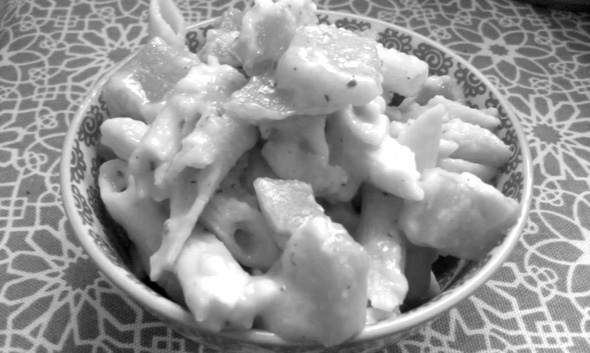
Cooking Corner: 15 Minute Butternut Squash Mac & Cheese


Katie Mancino | The Bucknellian

Katie Mancino
Columnist

15 Minute Butternut Squash Mac & Cheese

311 calories, 5g fat, 57 carbs, 16g protein

I’m a butternut squash addict. I love adding it to all kinds of dishes because it’s really healthy, hearty and tastes great, especially with spices like rosemary and thyme. This macaroni and cheese is a perfect fast and easy fall dish that tastes great and just happens to be good for you too. If you want, you can also add caramelized onion, carrots or other types of squash too.

Makes 6 servings

Ingredients

  • 4 cups raw butternut squash, cubed
  • 2 cups skim milk
  • 1 Tbsp. Land O’Lakes Light Butter
  • 1 cup Sargento Reduced Fat Italian blend
  • Rosemary, thyme, oregano, garlic powder
  • 2 Tbsp. all purpose flour
  • 1 box (12 oz dry) Rozoni Smart Taste Penne

Directions

  1. Put water (covered) on high to cook pasta.
  2. Over medium heat, melt butter, add milk, 1/2 teaspoon of each spice and squash. Cook 8-10 minutes until squash is fork tender.
  3. Add flour to squash and stir to mix well. Sauce should start to thicken. Then add in cheese. Mix until it melts, then continue cooking 2-3 minutes until thick.
  4. Drain pasta, toss with squash sauce and enjoy!
Categories
Arts & Life Columns Humor Rees' Pieces

Rees’ Pieces: Uncle Ben’s Story Time: Part 1

Ben Rees
Columnist 

C’mon kids, run on over here and sit pretzel style on the alphabet rug. Uncle Ben’s going to tell you all a story. This is the story of Jake’s first summer at sleep-away camp. I was there for the entire time; it was the summer after fifth grade. Now pull out your Capri Suns and Fruit Gushers, and plan to be swept away, off to that first summer years ago …. Wooshhhh.

Jake was a chubby and goofy youngster. It was his first summer away at camp, and he was in Wisconsin, the land of cheese, for four whole weeks before going home. After a great week of swimming, crying over splinters and general camp shenanigans, it was time for our cabin to go on the camping trip. We were going canoeing down what seemed like a torrential river, but what may or may not be currently classified as a creek. That aside, we packed up our knapsacks, bagged our pretzel sticks and set off on our excursion as a group of wholly unsuspecting children.

The first two days soared. We had a blast canoeing and camping; the s’mores were perfectly melted and the mosquitoes were nowhere to be found. All was well until the third day. We arrived at our campsite and set up the tents. The sky was clear and we were all going to go swimming in the river. I put on my hiking sandals and sweet graphic tee, pulled out my SPF 70 sunscreen and prepared to have the time of my life.

While I was readying myself, Jake was getting into some mischief. As I said earlier, he was rather chubby. He also had an unfortunate affinity for climbing trees. Another complication for Jake was that the area in which we were camping had been subjected to logging; the trees that had grown back were stock, meaning they were rather skinny and insubstantial. As you probably guessed, all of this leads to Jake climbing trees that he should not have. The first one he scaled sagged under his weight to just about 90 degrees.

The second time Jake shimmied up a tree, he was not nearly as lucky. There was a dead birch suspended over the river, and he attempted to walk out onto it. While it may have seemed cool at the time, in retrospect, he looked like a rotund Spider Man on a flagpole. As he got out onto the end and roared like a pre-pubescent silverback gorilla, the tree trunk started to creak.

The tree snapped, sending Jake plummeting towards the river; however, he was stopped short of the water by a rather large pile of sticks. His legs broke through the mound of timber, and all of a sudden, he began screaming. We all ran to the banks of the river in order to observe a shirtless chubby child halfway submerged in a mound of mud and twigs.  Jake continued to scream, as something furry was pawing his thigh.

To be continued … tune in next week for the riveting conclusion!

Categories
Opinion

Obama proves himself in foreign policy debate

Elaine Lac

Staff Writer

The foreign policy debate this round focused on several key countries and the United States’ relationship with them: Libya, Syria, Iran, Israel and China. In this last debate, President Barack Obama had to redeem himself after two lackluster debates against Mitt Romney. I believe he proved himself in his foreign policy expertise.

The current issues in Libya began with an attack on Sept. 11, where armed Islamic combatants entered the U.S. Consulate in the city of Benghazi. In the attack, a U.S. ambassador and three others were killed. Obama focused on his success in Libya. There was an effort to secure American safety, liberate Libya and assist rebels affiliated with the United States. He displayed more tact than Romney, and even though Obama could have been criticized for his response to the attack and intelligence failure, Romney didn’t press the issue.

On the issue of Syria, Obama has made it clear that he will provide assistance to rebels, but no arms. Romney, on the other hand, supported arms, but there was no clear evidence why he felt this way. Obama cautioned Romney and described him as reckless. Romney had little to respond with and merely repeated the need for arms distribution.

The Iran argument centered on Obama’s lack of crippling sanctions and military involvement, as well as getting rid of nuclear weapons. Romney criticized Obama on not placing sanctions on Iran, and once again Obama successfully countered by explaining that those sanctions on Iran were crippling. He also managed to get other countries to agree with these regulations which made them more powerful. Romney was left without a counter, and for the most part agreed with Obama’s stance.

Both candidates agreed that Israel was America’s greatest ally in the Middle East. When a hypothetical situation was brought up where Israel was about to bomb Iran, Romney refused to reveal his actions in the matter. He strongly believed that he would never be put in that situation. Romney’s refusal to answer showed me his inability to respond to high-stress situations, and made me doubt him more about this ability.

China became an opportunity for the two candidates to bring up economic policies again. Obama stated that China was to be treated as an ally and an enemy. They need to start following trade rules, and the import of Chinese goods needed to stop in order to create jobs. Romney tried to counter and say that cheap goods would save Americans money. Obama countered, saying that by stopping Chinese production of goods, there would be more American jobs created, which is the ultimate goal. Obama further criticized Romney for shipping jobs overseas because it was a cheaper alternative to the domestic workforce. He highlighted Romney’s contradictory business practices.

This debate ultimately did little to highlight the candidates’ differing policies. Romney lacks experience in foreign policy and focuses on touting his business expertise instead. While he may have this, he lacks well-roundedness on all of the duties of a president. During most of the debate, he agreed with Obama and only seemed to differ slightly for the sake of creating an argument. Obama has more consistency in all of the debates, and especially on topics of foreign policy. He was constantly fact-checking Romney and calling him out for discrepancies. I trust Obama more with the country. He knows what he’s talking about, and he has more experience considering his past term as president. Romney only appeals to me because he claims that he knows how to work with Democrats and Republicans to create policy. This is the type of change needed in the legislature, but how much of that is true? Only the election will tell, but as of now, Obama seems to have the clear advantage.

Categories
Opinion

Affirmative action usually not fair or effective

Elaine Lac

Staff Writer

Affirmative action is well-intended, but it undermines the ability of hard-working Americans. It was meant to help historically discriminated and disadvantaged races gain footing in higher education and better employment. Minorities tend to come from lower economic backgrounds, blocking them from opportunities and perpetuating their economic status. To level the playing field, many universities, for example, are partial to minorities during admission processes.

The recent, heavily debated Supreme Court case of Fisher v. University of Texas will likely redefine higher education preferential racial policies. Current policies allow universities to count race in admission policies holistically. This was previously determined by Grutter v. Bollinger after it was ruled that race could not be a quantified factor in admissions. In other words, affirmative action was overruled, but racial preference in admissions was not.

America was founded on the idea of equal opportunity for all. Affirmative action contradicts this by providing certain races an advantage over other races. It undermines the hard work of all students.

Affirmative action also often places students from lower class backgrounds into entirely different and unfamiliar surroundings where most students are from middle- to upper-class upbringings. This creates issues of integration, and students might struggle socially and make them feel isolated and depressed. Is it worth it?

Introducing diversity is an important goal for many institutions. For many students, college could be the most diverse place they are exposed to. Students from diverse backgrounds provide different perspectives that would be otherwise ignored in homogenous campuses. Students may not understand the issues of people outside of their social class, and understanding these issues allows people to be productive and sympathetic members of society.

The University tries a great deal to introduce diversity through multicultural events, the Posse scholarship program and the like. This is a much needed goal for its development. The University is an excellent educational institute, but the students primarily attracted to the school come from the same backgrounds and areas. Affirmative action seems like a good solution at this point.

It is difficult to consolidate students from diverse backgrounds and academic merit. Students with similar academic credentials tend to have the same upbringing whether they are minorities or not. Racial preference should not be done away with completely, but there needs to be an understanding between those admitted and those rejected. Minority students should be clear about the conditions of their acceptance. Was their race a factor? How do they compare academically? Will they be happy?

The gap between the admitted minority students and non-minority students’ academic performance should be closed. This can be justified either by the quality of their extracurricular activities or potential. Was it comparatively more difficult for one student to achieve honors than another student from an advantaged background? Does this equal harder work?

The Supreme Court will probably reform affirmative action, but not do away with it. It is valuable for diversity, albeit contradictory to American ideals. Sometimes exceptions have to be made for the greater good. In the interest of enriching the overall development of collegiate students, racial preferential policies are needed in higher institutions.

Categories
Opinion

ADHS meds used widely as study aid

Spencer Ivey

Writer

Do you want good grades? There’s a pill for that. Adderall is an attention deficit hyperactivity disorder (ADHD) drug that is becoming increasingly known to be a remedy for more than just this ailment.

If increased academic performance and Zen-like focus is as simple as swallowing a pill, then why not? The underlying issues here, which many 4.0-seeking college students might not choose to consider, pertain to unfair advantages and unclear medical consequences. The widespread availability of ADHD drugs like Adderall, in conjunction with a highly competitive college environment like the one on campus, is suppressing many students’ sense of good judgment.

To illustrate the ethical issues behind this matter, let’s take a look at the recent issue of Lance Armstrong with doping. Armstrong was taking performance-enhancing drugs on a regular basis and was able to gain an unfair advantage over the rest of the field. Of course, this is completely illegal and Armstrong is now suffering the consequences. The unsanctioned use of ADHD drugs to get ahead in schoolwork raises similar red flags, but colleges can only do so much to try to prohibit this behavior. Students who complete their work under their own power can do nothing but compete against the cheaters. Furthermore, kids and adults are now prescribed these drugs at an increasing rate, which creates widespread availability on college campuses. When the work piles up, as it often does, many students consider ADHD drugs to be the go-to study aids rather than a quiet, distraction-free study environment. Unfortunately, intense academic competition at the University can drive students to resort to these extremes.

Beyond ethical concerns, we must also consider the physical consequences of using ADHD drugs without the consent of a doctor. These drugs can cause both physical and mental addictions, and the scientific community has yet to complete many conclusive studies on the effects of their long-term use. Students without prescriptions waste a great deal of money buying these medications and may even go as far as faking a disease to get a prescription.

In the short term, students might get great grades using ADHD drugs and feel perfectly content with their decision to participate in this illicit activity. However, this approach seems shortsighted to me. I believe that these students will regret their decision in the long run when they are struggling to find a natural way to complete their work. Yet, the use of ADHD medications without a prescription to get ahead in school will not fade easily. The reward is too enticing, and a school with the University’s prestige is not going to ease up on academic rigor anytime soon.

Categories
Opinion

Lewisburg fosters fun fall culture

El McCabe

Writer

Fall at the University is not only the time when academics are heating up, but it is also a time of beautiful trees, leaves and brisk air. When walking around campus, it is impossible not to notice the numerous shades of the rainbow in the leaves of our picturesque trees. After all, the University is ranked among the most beautiful colleges in the nation. There are also perks to living in the town of Lewisburg itself this fall season.

For example, Ard’s Farm is an opportunity unique to Lewisburg. Ard’s Farm is a restaurant, mom-and-pop shop, pumpkin patch, corn maze and market all in one. There are shuttles from the University that take students to the farmer’s market every Friday, making it an easy and perfect way to start a weekend. You can purchase pumpkins to carve for hall bonding or even just to decorate your room. Finally, Ard’s Farmer’s Market is a fun change of pace and offers an easy way to take a break from Caf food. The menu features delicious pulled pork sandwiches, fresh burgers, shepherd’s pie and countless other delicious items.

Additionally, downtown Lewisburg offers many fun fall- and Halloween-themed events. This Saturday there is a “Rocky Horror” showing at the campus theatre–admission includes a prop bag–and the ticket itself is only $10. This event highlights Lewisburg’s spirit during fall and excitement towards Halloween.

Lewisburg is the ideal place to live this fall because of the town’s dedication to and appreciation for the arts. Between performances at the Weis Center for the Performing Arts by musicians, singers and groups, and art galleries in town and along the Poetry Path, it would be an understatement to call Lewisburg “cultured.” Not many college towns offer such diverse ranges of expression in the arts, and students should definitely take advantage of what our town has to offer.