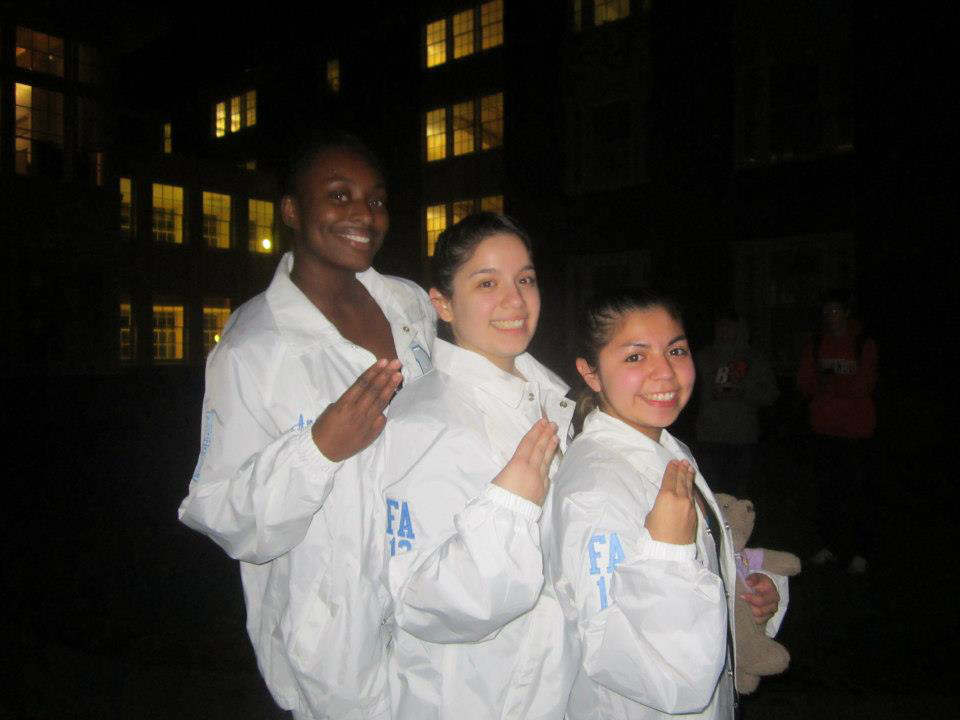
After the sad removal of Pi Beta Phi sorority from campus at the start of this semester, it is encouraging that Alpha Xi Delta sorority will be joining the University’s Panhellenic ranks this spring. While adding yet another organization to the Greek system on campus seems like it may increase the overall Greek presence on campus, it may accomplish more positive goals than negative ones.
“The goal of extension is to increase the opportunity for interested women to become affiliated and to slightly decrease the average sorority chapter size,” Kevin Pons, assistant director of sorority life, said.
This goal of greater opportunities is right in line with perceived needs of the Greek system. We see a major disadvantage of sorority life compared to fraternity life at the University in the sororities’ significantly larger sizes. With approximately 135 members per sorority compared to about 70 per fraternity, the sororities can’t offer the same kind of intimate relationships the fraternities are able to cultivate. The boys’ smaller pledge classes provide them with more intimate settings to get to know each other and form a common bond.
In addition to the more intimate relationship opportunities, a smaller chapter size allows for more leadership roles. With fewer girls vying for limited positions, more women can benefit from the leadership aspects of the Greek system. The smaller chapter size will also help with individual accountability of the members. With the current sizes, it’s easy for members to get lost in the shuffle and not be missed from mandatory events, like chapter meetings, philanthropy events and speakers; with a smaller size, it will be more difficult to bail on these things.
Fraternities will also benefit from the additional chapter in social and philanthropic opportunities. With another organization to participate in events, we believe the fraternities will be given more women to interact with and have the chance to meet another group of women with their own personality.
Beyond the benefits from changes in chapter size and relationships with fraternities, the addition of AZD will bring a new sense of attention to next fall’s formal recruitment. The increase in competition from the new chapter will force all of the sororities’ recruitment chairs to up their game and fight for their ideal pledge classes.
Hopefully, these benefits will pan out over the next year and the University will have the opportunity to open the campus for extension again to accomplish the same goals, continuing to propel Greek life to success.
Since its creation, “Bicycles Against Poverty” (BAP) has provided 386 bicycles and affected the lives of over 2,000 people, weekly. BAP is an organization founded in 2008 by University student Muyambi Muyambi ’12. The organization provides bicycles to low-income workers in northern Uganda. These bicycles are a form of transportation and promote economic development. These people have access now to better markets, farms and clinics.
Currently BAP is offering various internships and opportunities for involvement to University students. These internships will take place during the school year and are an opportunity for real professional work. They are also based around BAP’s cross-country cycling trip, which is a fundraiser for the organization. A University student team and possibly one from Skidmore College will help plan the event. The internship is best suited for management majors, but it is open to anyone interested. BAP looks for proactive leaders who take initiative and show passion, motivation and work hard.
There are several positions open: two spring internships, three summer positions and three cyclist positions. The spring internships will learn how to plan campaigns, manage teams, reach out to the media and coordinate events. Spring internships are focused on planning and marketing for the cycling trip fundraiser to be held in the summer. The culmination of the internships will be planning the training for the six summer members for the summer cycling trip.
The summer interns will learn how to fundraise, put forth messages, management, organize, media pitching, communication and planning. Interns will be divided up into different areas to focus their skills, but will still likely be exposed to all parts of the process. These interns will also accompany the six cyclists who will be participating in the fundraiser. Three of these cyclists are also recruited from the University. These cyclists will learn team management and write daily blogs.
Those interested in applying for the spring positions can email their resume and a letter of interest to Molly Burke at mburke@BicyclesAgainstPoverty.org by tomorrow. There will be interviews conducted afterwards on Dec. 3 and 4. Those interested in summer positions can also reach out for more information, but details are yet to come.
Recently, the University received a $300,000, three-year grant from the Department of Justice Office on Violence Against Women Campus Grant Program. Across the nation, only 21 other colleges have been selected to receive the same grant.
“This grant program is very competitive and is highly sought-after funding for colleges and universities nationwide each year. Receiving this grant is an honor, recognition of the work we are doing and validation of our collective campus leadership and the direction in which we are headed,” Tracy Shaynak, director of the Women’s Resource Center, said.
The grant will be used to expand education and enhance services that will strengthen responses to many issues both on and off campus, including dating violence, sexual assault and stalking.
“We will partner with student leaders, our Speak UP Peer Educators and others to actively engage more students in the work that lies ahead. We can’t accomplish what we need to without more students stepping up and recognizing that everyone has a stake in these issues, and everyone has a responsibility to promote and protect a safer campus for all students,” Shaynak said.
Mainly, the grant will be used to fund a prevention coordinator position, one dedicated to enhancing education for students focused on promoting positive bystander behavior. The grant will also help offset costs for the Speak UP Bucknell Peer Education program.
Co-directing the grant with Shaynak is Marie Shaw, a psychologist for Psychological Services.
“The work from this grant will have an impact across campus with many departments as well as off-campus partners. For example, a campus community response team has been created to achieve greater coordination and communication among services both on-and off-campus. Additionally, a new position focused solely on coordinating prevention services has been created,” Shaw said.
The grant also allows for the Women’s Resource Center to work with Transitions, a local crisis center affiliated with the Pennsylvania Coalition Against Rape (PCAR). This collaboration will provide training for local law enforcement both on campus and downtown, and also give opportunities to work with survivors of assault and other issues.
“The expected outcomes we hope to achieve at the conclusion of the grant include enhanced relationships with newly formed Buffalo Valley Regional Police Department, Public Safety, Transitions and campus,” Shaw said.
“I am most excited about this grant because it validates that Bucknell has its programs, initiatives, relationships and future goals aligned that will allow us to move forward and begin to create meaningful awareness and change on our campus. That, in combination with working with students who are committed to partnering with us in this process, is incredibly rewarding,” Shaynak said.
Geographic Information Systems (GIS) is not only important in its ability to help environmentalists better conserve global resources and protect biodiversity, but also in its recent demand among employers. The University’s Office of Library and Information Technology recently hosted a GIS conference from Nov. 16 to 18, which drew an impressive crowd of professors from 50 different liberal arts universities and colleges, in addition to University faculty members from assorted fields of academia.
The gathering was held to discuss GIS, a specialized computer software used for making maps and conducting spatial analysis. This program is being incorporated increasingly across an array of professional disciplines, from a wide range of companies and businesses to various branches of government, in order to help manipulate and analyze data.
As a result of its growing use across these many applications, there is an increase in demand among employers for employees who are proficient in GIS, a statistic identified by the department of labor. This program is being used across campus in various disciplines to give students a different way of understanding the material they are working with and to help put data into perspective.
Beyond the professors in attendance, a large group of students attended the conference, which was compromised mainly of three work-group sessions that focused on a multitude of topics about GIS.
Conversation varied from qualitative analysis of GIS to its application in community outreach and service learning. Each session was divided into presentations followed by group discussion, a format that promoted energy and brainstorming among participants about the theme-based material.
The conference’s enthusiastic reception by the student body comes as no surprise. Many professors from other colleges continually referred to the University’s approach to GIS as the ‘Bucknell Model for GIS,’ a well-deserved compliment to the faculty’s hard work in developing and incorporating GIS into academic life here at the University.
The buzz surrounding the conference even lit up Twitter, where attendees exchanged tweets praising its success. Readers who are interested in learning more about GIS can contact the Office of Library and Information Technology.
Ally Boni | The Bucknellian Alex Lyras brought Steve Jobs’ legacy to life in “un/real and un/true: The Agony and the Ecstacy of Steve Jobs.
Christina Oddo
The Bucknell Forum “tech/no” National Speaker Series hosted an original University production to unveil the fact and fiction surrounding the life of Steve Jobs and the ever-encompassing hold Apple has had, and continues to have, over the world. Starring Alex Lyras ’93, a successful solo theatre writer and actor, and directed by Bob Gainer, the play within a play also included faculty members and students as part of the cast, or writing or research teams. “un/real and un/true: The Agony and the Ecstasy of Steve Jobs” took place on Nov. 27 at 7:30 in Trout Auditorium.
Ally Boni | The Bucknellian Lyras gives a realness to Jobs in the Agony and Ecstacy of Steve Jobs.
“Before joining this project, I had no idea how much time and effort went along with putting on a production of this size,” Rachel Litt ’13 said. “Maybe my jaded Bucknell mind that craves instant gratification merely thought speakers appeared out of thin air and arrived on campus for our entertainment. But it’s so much more than that. Scheduling, script editing, rehearsals … and that’s just the tip of the iceberg.”
This play was based on the original production of The Public Theater, “The Agony and Ecstasy of Steve Jobs,” starring Mike Daisey, the writer of the play. The production utilized and reduced Daisey’s original script, with his permission.
“Being a member of the script writing committee … we chose the interruptions, completed the research, wrote the insertions and lastly placed them in the script,” Litt said. “It was challenging, but so much fun.”
In fact, the original script and the controversy around it more generally aims at the question of whether technology is ultimately good or bad, a question that captures the essence and goals of the “tech/no” series. The University’s play within a play unfolded a series of debates that the task force shared in trying to find the truth.
“I got involved in the play because I am in Business, Government and Society with Professor Jordi Comas, and he was one of the producers of the play,” Kathleen Lenox ’13 said. “For homework, we listened to the original podcast of Mike Daisey performing ‘The Agony and the Ecstasy of Steve Jobs’ on National Public Radio’s ‘This American Life.’ I was listening to Mike Daisey reveal the horrible working conditions at the Foxconn factory … and became frustrated with myself. A week later, we listened to Mike Daisey’s retraction in which he admitted that he fabricated many details. I then became frustrated with Mike Daisey. He lied to a lot of people. This frustration led to a curiosity of the actual truth, which had to lie somewhere between Apple’s glossy investor reports and Mike Daisey’s ‘reporting.’ Thus, when I heard about the opportunity to join the forum and share the truth with an audience, I took it.”
Daisey focused “The Agony and Ecstasy of Steve Jobs” on the immorality associated with factory conditions in Shenzhen, China. The rest of the issues surrounding Jobs and Apple branch from the idea that people should be responsible for knowing where their technology and other items come from. “un/real and un/true: The Agony and the Ectasy of Steve Jobs” presented fact and fiction through Daisey’s supposed view of Jobs, alongside Daisey’s fabrications and exaggerations.
Throughout the play, faculty stood and spoke about what they believed was the truth. For example, Zhiqun Zhu, MacArthur Chair of East Asian Politics and associate professor of political science and international relations gave his opinion that Daisey generalized superficial phenomena.
The audience was presented with statistics that served as facts: Foxconn, stationed in Shenzhen, is responsible for 50 percent of all of the electronics of the world. A live interaction with Siri on the iPhone was also presented by Lenox as a fact; Siri will not answer a question regarding the iPhone’s origin.
Further, Daisey’s voice continued to describe the factory conditions, especially by stating the suicides that have occurred, and the precautions that Apple has supposedly taken to stop the madness: putting up nets around the area. The play shifted to an interview with Jobs, who stated that 13 out of the 400,00 people employed in the factory had committed suicide over the course of a particular year, and that was under the U.S. suicide rate. As a company obsessed with detail, according to Daisey’s words, how could they not know what was ensuing in these factories? Apple merely sees what it wants to see.
Problems regarding fact and fiction arise, in particular, to the n-hexane issue. As a narcotic agent, clearly dangerous to humans, n-hexane, supposedly used in the factories, harmed workers, according to Daisey. However, through later research and interviews, it became clear that Daisey had never met a worker who had been affected by n-hectane. Moreover, when interviewing Cathy Lee, Daisey’s translator at the time, it also became known that Daisey had exaggerated other details (for example, that the guards at the gates held guns). Where should the line be drawn between exclaiming fabricated and truthful accounts with the aim of proving a point?
“Rachel Litt, Nick Stetz ’13 and I poured over his original script looking for ways that we could show how nuanced reality actually is,” Lenox said. “We did not set out to prove that Mike Daisey was a liar, but that his truth was not factual enough to give his audience a good understanding of what is actually happening in China.”
The audience was left with questions to prompt thought and further discussion.
“Our ultimate goal was to show the audience that they should question whatever piece of information they are shown; they should not take it as fact,” Lenox said. “We wanted to show the nuances of the truth that exist depending on the source and to encourage the Bucknell community to think critically about what is really happening.”
Yessica Martinez | The Bucknellian Bucknell welcomes new multicultural soroity, Mu Sigma Upsilon, to the greek community. They are a national sorority that welcomes diversity.
By Siobhan Murray
Senior Writer
Mu Sigma Upsilon Sorority, Inc., the first multicultural sorority in the nation, takes pride in its foundation. More specifically, it takes pride in colonizing here at the University. Recently, the University welcomed Mu Sigma Upsilon to campus with its formal probate, or “coming out” ceremony, that took place earlier in November.
Yessica Martinez ’14, president of the University’s chapter of Mu Sigma Upsilon was more than pleased with the response to their formal initiation ceremony.
“We were very nervous because we had practiced for some time and we wanted it to go perfect,” Martinez said. “We were very surprised with the crowd. It was very comforting to see that people were interested and curious in our organization and came out to witness our initiation. We have received positive comments since, and we appreciate everyone who has welcomed us to campus.”
As a multicultural sorority, Mu Sigma Upsilon does not exclude women because of their background.
“Everyone is different and that is what we embody. Our motto resembles exactly that: ‘Mujeres Siempre Unidas’ (‘Women Always United’). Our Founding Mothers decided to create this sisterhood as a support system for all women, ‘a student organization that celebrates diversity and fosters progress,'” Martinez said.
These five women founded Mu Sigma Upsilon, with the intent to unify women while observing their differences.
“We will follow through with what our Founding Mothers intended this sisterhood to be. We are excited to grow as a strong sisterhood and showcase all we have to offer to our community,” Martinez said. “As we do not fall under the Panhellenic Council, we do not participate in Rush, so we have no incorporation with formal recruitment. Instead, our interests will be participating in an orientation process. We go more in details about our process at our Ladies Night, and we encourage all those women who are interested to attend … These sessions will be advertised, so just be on the lookout. If there are any questions, interests can contact Angel Crockett (acc020).”
The University’s Campus Climate Report released last fall caused a stir around campus. Doug Bogan ’14 was determined to do something about it.
On Nov. 29, Bogan hosted “The Bucknell ‘Rage Crew:’ is this all we really are?” which is the first student-led discussion for students only (no faculty) about the Campus Climate Report.
“Our goal is to give students the opportunity to not only discuss their thoughts on these matters, but to brainstorm action steps to directly address these issues,” Bogan said.
Bogan’s interest in this matter is rooted in his years of experience using this discussion model. Alongside training from his mother, Lisa Bogan ’78, he has managed to change high school start times and successfully host 1,000+ person concerts.
“[The model] emphasizes consensus building among participants surrounding action steps to address an issue through small group discussion,” Bogan said.
When the Campus Climate Report was released, Bogan and his mother wondered how students’ voices were going to be heard by the school administration. They were interested in starting a community conversation, and having students and the administration collaborate on “post-report change.”
Both Bogan and his mother presented their idea to administrators as a student/alum collaborative effort.
“We received incredible support and enthusiasm surrounding the concept,” Bogan said.
Students involved on the planning committee for this event include Robert Owoyele ’13, Kari Ayoob ’15, Caroline Confort ’14, Alaina Eisenhooth ’13, Pat Zailckas ’14, Ian Hackett ’15 and Mark Paleafico ’13.
Preparation over the past eight months has included working with the deans, promoting the event and recruiting and training 27 students to be moderators at the event. These moderators led small-group discussions to brainstorm how to take action.
“We expect that the steps needed to take action will be thoughtful, reasonable and directly applicable to student life here on campus,” Bogan said.
Common sentiments and plans of action amongst the groups will be presented to the administration, followed by a formal report.
Last year, there were two open student forums, one hosted by President John Bravman and one by Bucknell Student Government (BSG), but Bogan’s event reminds us that it is important to continue the dialogue.
Alpha Xi Delta is one of the founding members of the founding fraternities of the National Panhellenic Conference, boasts over 150,000 initiated members and plans to establish its next chapter at the University. Alpha Xi hosted an information session for interested women on campus on Nov. 27 from 5 to 7 p.m. in the Gallery Theatre. A full fraternity-coordinated colonization effort will take place in spring of 2013, which will be followed by a five-year period of care to ensure the new chapter’s success. We sat down with Assistant Director of Sorority Affairs Kevin Pons to discuss how this sorority will fit into campus life.
What does this new sorority have to offer over other sororities that we could have invited to colonize on campus?
“We are confident that Alpha Xi Delta is the best choice for Bucknell and we look forward to welcoming them to campus in the spring. Alpha Xi Delta was selected from seven National Panhellenic organizations that applied to colonize at Bucknell. An extension committee comprised of staff and students selected AZD for many reasons. Some of these reasons include diversity of their national philanthropy (Autism Speaks), strong support from area alumnae, strong support from the national headquarters, campus presentation and interviews and more.”
Why did we decide to bring another sorority on campus?
“Bucknell University Panhellenic decided to open for extension last year. The goal of extension is to increase the opportunity for interested women to become affiliated and to slightly decrease the average sorority chapter size. Our goal over time is to have our sororities closer to 100 members, as opposed to the average of 135 we are seeing now. In doing so, we will be able to create stronger organizations and maximize the opportunity for students to assume leadership positions.”
How will this affect Rush next year?
“Alpha Xi Delta will be recruiting women this spring to join their colony. The plan is to have the chapter fully chartered by the end of the academic year. Alpha Xi Delta will participate in formal recruitment with our other six NPC groups next fall, ultimately increasing the opportunity for women to join our thriving Panhellenic community.”
Do we plan on adding any other sororities in the near future?
“In addition to Alpha Xi Delta, we have invited Delta Zeta to re-colonize no sooner than the spring of 2015. Delta Zeta previously had a chapter at Bucknell and continues to have a strong alumnae group committed to the success of the new colony in the near future. This agreement will be revisited closer to 2015 to ensure it is still mutually beneficial.”
Recently, Bucknell Student Government (BSG), in partnership with representatives from the Collegiate Readership Program, made the decision to provide students with online access to the New York Times.
“Since college students wouldn’t purchase online access anyway, I think it’s incredible that Bucknell is willing to pay for this service,” Brandon Dellafave ’16 said.
The Collegiate Readership Program, available at many universities through USA Today, encourages students to increase their knowledge of world events, by providing complementary online access to publications such as the New York Times, USA Today and the Financial Times. Throughout this process, the BSG Executive Board met with members of the USA Today Collegiate Readership Program to discuss newspaper consumption and demand.
“I think this access is what the campus needs. Students like being informed and this is one way BSG can make it easier,” Dotun Odewale ’13 said.
This program allows students to obtain a 24-hour access pass, where they can log onto NYTimes.com/passes and using their bucknell.edu email address, view the online edition as well as archival articles.
“If it’s a 24-hour pass and it’s reusable, why can’t we have unlimited access? I don’t blame Bucknell for this,” Tom Lukow ’16 said.
As with the campaign to increase college readership of publications, the University hopes to strengthen its partnership with programs such as the Collegiate Readership Program.
Alyssa Dunn ’13 has played a critical role in the resurgence of the women’s basketball team in its young season. After suffering tough losses in their first two games of the season against Xavier and Saint Francis (Pa.), the Bison have won three straight games against Canisius, Niagara and Morgan State.
In the win against Canisius, Dunn scored 22 points, setting her personal record. But in the game against Niagara just four days later, she broke her record by scoring 23 points, going 6-12 from the field and making all eight of her free throws. She also made all three of her attempted shots from behind the three-point line. As if that wasn’t enough, she also had a career-best six assists.
“My teammates found me in good positions to score, and we were able to create transition baskets with our defense,” Dunn said.
Dunn continued her hot streak against Morgan State, scoring 15 points to lead the team in that category, including another perfect night at the free throw line, going nine for nine. Not only did she put up impressive numbers, but she also performed her best when she was needed the most. She scored all but three of her points in the second half to help the Orange and Blue make a comeback.
In the Patriot League, Dunn ranks third in scoring (15.6 points per game), first in free throw percentage (.929) and sixth in field goal percentage (.490), assists (3.6 per game) and assist/turnover ratio (1.1).
Dunn and the Bison will look to continue their prime performance when they take on Buffalo tomorrow at 7 p.m. in Davis Gym.