Categories
Arts & Life Uncategorized

Rebuilding from Katrina

By Ben Kaufman, Madison Lane, and Nikole Stevens
Layout Editors and Contributing Writer

Early Jan 9, a group of groggy college students and faculty, staff, and administrators began their journey to New Orleans for a week of Hurricane Katrina relief. The trip was a “Service Learning Trip” organized by the Office of Civic Engagement, but it was much more than just building houses or going on vacation. It was a life-changing experience.

Every January and May since 2006, the Hurricane Katrina Recovery Team has traveled to New Orleans for a little over a week to help rebuild. Janice Butler, director of civic engagement and service learning, has organized the trip each year. “While I’ve definitely seen changes in the past five years, a lot of folks continue to struggle, and we owe it to these resilient people to lend a hand,” she said.

Although some past groups have worked with Habitat for Humanity, this January we worked with the St. Bernard Project, which was founded in March 2006 to help victims from the St. Bernard Parish return to their homes and communities. After Hurricane Katrina, 100 percent of the houses were deemed uninhabitable, making it one of the hardest hit areas in Louisiana.

Today, New Orleans still needs our help. “The amount of work still to be done is astounding,” said Eryn Nagel ’12, who first visited New Orleans in June 2007 and returned with us this year. Houses are still in disarray, and entire neighborhoods have been destroyed. It is obvious that some houses have barely been touched since the hurricane hit, some still with the spray-painted “X” on their siding from the initial searches.

We were lucky enough to meet the people of New Orleans and hear their first-hand experiences. The first person we met was Dr. Lopez, who was working at Charity Hospital in the heart of the city. He and his staff stayed in the hospital for five days after the storm to take care of patients. Even when the power went out and they had to rely on manual work, they saved over 200 people. He said that the experience was life-changing and made him remember why he became a doctor. He was very inspirational, and after we heard his story, we went to work more motivated and ready to help.

We then met Paul Perez. Perez’s family was one of thousands that were displaced after the storm. After the St. Bernard Project helped his family get back on its feet, he decided to thank them in the best way he knew how: food. Every month, his family and a small group of other families cook a homemade meal for all of the volunteers working at the time. At this dinner, Perez showed us a slideshow about the “angels” on Earth that have helped him. Seeing pictures of his family before and after the storm, along with the tears of love on his face when the lights came back on, were more thanks than anyone could have asked for.

Later in the week, we spent a day in Mississippi to learn about the damage there. Most of us had no idea that Mississippi was even hit by Hurricane Katrina, but once we were there the devastation was apparent. Chris Lagarde, former aid to Congressman Gene Taylor, gave us background information about the effect of the storm on his town of Bay St. Louis. In New Orleans homes were damaged by floodwater and remained, but the homes in Mississippi were churned by the storm surge, and the receding waters pulled the debris back into the Gulf of Mexico. Entire homes were missing from their lots of land, even five years later. Not many people realize that Mississippi experienced so much damage, but they are still rebuilding just like New Orleans. After working for the day on a house that Lagarde recently purchased, he showed us true Southern hospitality by inviting us over for a traditional boiled shrimp dinner and a bonfire.

One thing everyone noticed was how positive people are. “I was struck this time by how many people thanked us for not forgetting them and the city,” Provost Mick Smyer said. “There is still so much to do, and New Orleanians are worried that the country and the world have forgotten about them.”

Anyone interested in going on a future trip should visit the Office of Civic Engagement in the lobby of Ellen Clarke Bertrand Library. Donations can be made at www.stbernardproject.org. Above all, do not forget New Orleans.
Categories
News

Famed mountain climber to speak at University’s 161st Commencement

By Olivia Seecof

Contributing Writer

Erik Weihenmayer has been selected as the speaker for the University’s 161st Commencement on May 22.

Weihenmayer is an author, filmmaker, humanitarian and mountain climber who, in 2001, became the only blind person in history to reach the summit of Mount Everest. He then worked to ascend the highest peaks on all seven continents.

“As a graduating senior soon to enter a world that can at times seem intimidating and untouchable, Mr. Weihenmayer reminds me of the great capacity for achievement that every one of us possesses,” said Gar Waterman ’11, a four-year member of the Outdoor Club.

The speaker also co-founded a not-for-profit organization, No Barriers, that promotes technologies and techniques to help people with disabilities lead active lives.

Weihenmayer has received multiple awards and honors including the Helen Keller Lifetime Achievement award and the Freedom Foundation’s Free Spirit Award.

While Weihenmayer is extremely accomplished, many are unaware of his story. “At first I was disappointed [in the choice of the speaker] because I was not familiar with him, whereas I had prior knowledge of the speakers for the past two graduation ceremonies.  However, after reading about Weihenmayer and his impressive achievements, I highly anticipate his speech,” Sarah Leung ’11 said.

“He had the drive and passion to achieve his dreams. I think he will be inspiring and will be a great voice to usher us into our own future,” Lexie Rueckle said .

Weihenmayer’s film “Farther Than the Eye Can See” was nominated for two Emmys and was named one of the top 20 adventure films of all time by “Men’s Journal.”

Another film production, the highly acclaimed documentary “BlindSight”, accounts Mr. Weihenmayer’s successful efforts to aid six blind Tibetan adolescents up the north side of Mount Everest.

The University plans to show “BlindSight” later in the semester to introduce Weihenmayer’s story.

“At Buckwild we did ledge climbing that was difficult, so I can’t imagine climbing Everest blind!  His story inspires me, and I’m sure all other outdoorsy people as well,” Maddie Pucciarello ’14 said.

“I think it will be very motivational, inspirational and a unifying time of reflection for the entire class,” Chelsea Burghoff ’11 said.

Mr. Weihenmayer’s story is remarkable, and he understands that there is more in the world than physical ability.  The class of 2011 and the University community are looking forward to his commencement speech.

“I believe Mr. Weihenmayer would probably be the person that best understands that climbing mountains is not just about the view from the top,” Waterman said.

Categories
News

Creative flash mob promotes Greene lecture

By Carleen Boyer

Contributing Writer

On Feb. 8, physicist Brian Greene will visit the University as part of the “Creativity: Beyond the Box” speaker series.

Brian Greene, a professor of mathematics at Columbia University, has done research on string theory. His work may help explain many of the mysteries of our universe.

To publicize this event, the Bucknell Forum Task Force has organized a human visualization to explain the formation of the sun and the Earth.  Students can gain a perspective as to how our universe and solar system began through this demonstration, known as a flash mob.

“It helps people who are unfamiliar with the subject by having a visual to understand it,” Kim Davis ’14 said.

“We had a nice visual because in the star formation stars don’t start out by glowing. That comes out of the high temperatures and high pressures,” said Margot Vigeant, associate professor of chemical engineering, who is on the team for the “Creativity: Beyond the Box” forum series.

Greene, the bestselling writer of “The Elegant Universe,” has worked to explain string theory and the principles behind it in a way that the general population can understand.

“He’s a popular science writer, and he is explaining some of the crazy, creative stuff that people have had to come up with to explain the universe,” said Jeffery Bowen, associate professor of physics.

Greene has been able to use his own creativity to explore things that are unseen. Unlike many other research areas, string theory is not visible in our everyday life. “Imagine thinking that the universe is nine spacial dimensions,” Bowen said. “That’s pretty out of the box.”

“Since physics isn’t exactly widely discussed outside of a particular technical circle, that takes a lot of creativity and enthusiasm to reach out in the way he’s made his work have a meaningful impact,” Julie Uptegraff ’14 said.

Vigeant discusses the importance of applying creativity to all fields of study.

“In last week’s State of the Union address, the President cited innovation as one of the ways to ‘win the future,’ and innovation relies heavily upon creativity,” Vigeant said. “Now creativity is becoming part of the discussion campus wide. This forum gives us a chance to focus on how creativity is valuable and worth cultivating for everyone on campus as a part of becoming educated people.”

Categories
Featured News

New BSG execs

By Eliza MacDonald

Contributing Writer

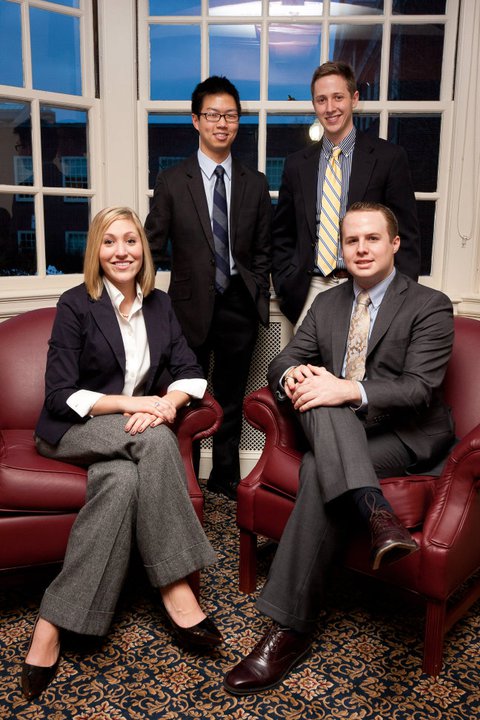
The new Bucknell Student Government executive board.

The Executive Board of the Bucknell Student Government (BSG) is kicking off a new year with four new board members.

The new board will serve as administrators of all BSG representatives and activities for the next calendar year.

“Our primary role is to voice the concerns of the student body, to act as a sounding board for students on campus and to act as a liaison between faculty and students,” President Phil Kim ’12 said.

Kim, who was abroad last semester, is a veteran of the BSG, along with two other executive board members: Joey Martin ’12, Vice President of Operations, and Matt Kairys ’12, Vice President of Finance.

Martin’s job consists of handling the internal workings of organizations, committees, election procedures and club recognition.

As Vice President of Finance, Kairys handles appropriating funds from the student activity fee to various student organizations and helps to plan various budgets.

Abby Vidmer ’13 is the newest member to the BSG and serves as the Vice President of Administration, working to make the efforts of the BSG more transparent to the student body, keeping track of attendance at meetings, and taking minutes at congress.

The main concern of the Executive Board is to “make sure that the organization is running at the best that it can be,” Martin said.

“The executive board positions demand a significant commitment, and students really must put extra effort into maintaining a good balance between academics and their BSG role,” said Associate Dean Kari Conrad, faculty adviser for the BSG. “Most are in the position because they are passionate about Bucknell and want to make a difference.”

Conrad considers her position as adviser “incredibly rewarding” and said that in her 11 years as adviser, she has been increasingly impressed by the quality of the students who take on the leadership roles within the Executive Board.

Since this new board is starting half way through the year, their job is to keep the work of past executive boards consistent through the next year. The new board’s first and foremost initiative is to re-evaluate BSG by further defining its purpose and function, as well as what its members want to achieve.

One of their goals is split into two major parts. The first is to incorporate outside opinion into the BSG in an effort to better understand what students are thinking. Gathering student opinion is helping them to engage the students at large.

“We think that it is a phenomenal way to reach out to students and get a good understanding of what they’re thinking, so that when we make a decision, we’re making better-informed ones,” Kim said.

Their plans for engaging student involvement are to use surveys, hold discussion groups, and to have BSG members approach students for face-to-face connections. The latter also relates to the second piece of their other goal for the upcoming year.

The second part is to make their work and efforts more transparent to the student body. Most students are probably unaware that certain programs such as ZipCar, the Café in the library and the new equipment in the gym are brought to them by the BSG. The Executive Board hopes to increase awareness from their attractive new office space.

The group feels that their new location across from the Bison Café will make them more accessible to students.

“We want you guys to know that we’re working for you and want to have your opinions coming through the door,” Kim said.

They also hope to update their page on the University’s website.

“[We are working on] finding someone to work with us on it to make it more informative with our updates on events or goals,” Vidmer said. Any and all aspiring web designers interested in helping should contact Vidmer.

“In every corner of Bucknell, BSG has some involvement, and we want to make it clear that we are here if any student wants to talk about anything or voice any concerns. We’re looking for that kind of feedback,” Kim and Martin said.

The Executive Board members invite all students to come by their door and say hello or voice a concern or an idea since they will be considering your concerns and opinions for the next calendar year.

Categories
News

100 nights cancelled

By Nicole Brigg

Contributing Writer

Many seniors were shocked by the news that the traditional event 100 Nights was canceled this year. The Office of Alumni Relations and the Career Development Center, who host the event, have a replacement for it in the planning stages.

“We are all working extremely hard to plan a new tradition and hope to far exceed expectations and quell any initial disappointment associated with the cancellation of 100 Nights,” said Michelle Beck ’11, a 2011 Homecoming host who is on the student planning committee for the event.

100 Nights was a celebration that began a countdown to mark the last days until graduation. There were slideshows played and pictures taken. Students were able to look back through their scrapbooks they made for First Night their first year. They saw this as one of their last chances to all be together and look forward to commencement.

Since the event began in 2006, its purpose was to connect the senior class in a meaningful and lasting way, but throughout the years the significance of the special occasion disappeared.

“The trend our office saw was the event turning farther and farther from its original goals,” said Jenna Tesauro, Manager of Extracurricular Interests in the Office of Alumni Relations.

Now, they are committed to sponsoring an event that goes above and beyond what the students could do independently to bond themselves as a class.

“Specifically, excessive alcohol consumption and other safety issues became a problem in the past few years and presented a liability risk to the University,” Beck said. Problems even went as far as vandalism.

The Office of Alumni Relations takes full responsibility for the way in which the news was broken to the senior class. “The timing was not ideal,” Associate Director of the Office of Alumni Relations Kristin Stetler said. “But 100 Nights is changing into something much more meaningful.”

Committees of both members of the Office of Alumni Relations and members of the senior class have been working to develop a new event to replace 100 Nights.

“Through discussions with the Office of Alumni Relations and Career Development, the Homecoming hosts and hostesses and BSG 2011, it has been proposed to host an event, paired with a formal dinner, for all members of the Class of 2011 to formally gather prior to the end of the semester,” Beck said.

Elements of the old event will remain, such as the slideshow, as well as possibly having a photo booth and a professional photographer present to record the memories.

This event is tentatively scheduled for April 1, 2011.

Categories
Headline News

Former bookstore converted to student space

New student space
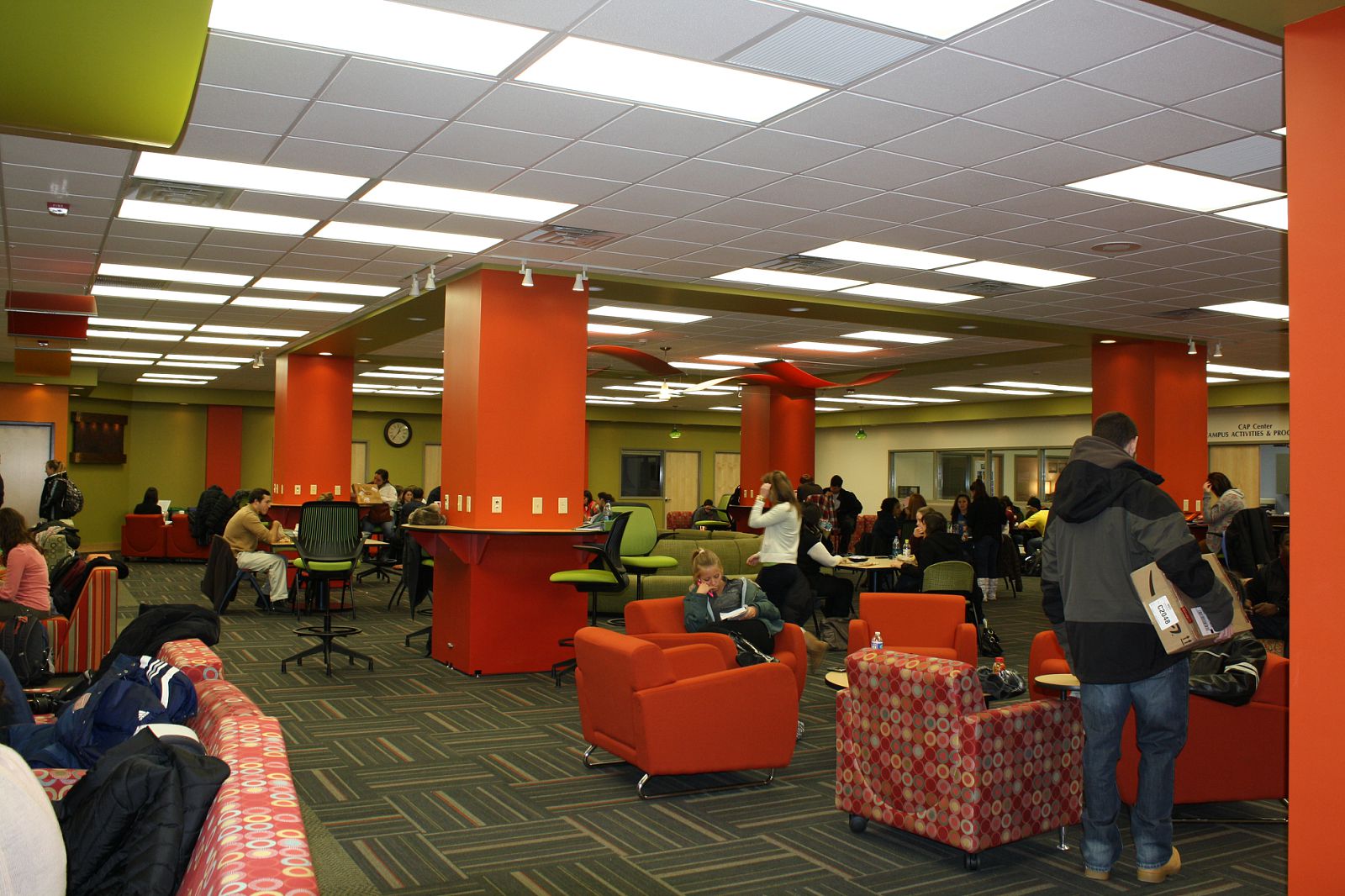
A new student space filled the former bookstore location.

By Sam Krassenstein

Contributing Writer

After months of planning by a committee partially comprised of students, the new student space is now open and equipped with plentiful couches, open walls, mobile chairs and tables.

The bookstore’s move to downtown Lewisburg opened more than 12,500 square feet of space in the Elaine Langone Center (ELC). Following Winter Break, the student space is now home to the largest indoor and most brightly colored student area on campus.

“The new student space is highly attractive and accessible to all students. I think it gets a lot of traffic in an area that used to be under-utilized. It’s greatly needed for the students and it’s nicely decorated and attractive to everyone. I think it gives student organizations a lot more visibility and it allows students to see what BSG [Bucknell Student Goverment] and ACE [Activities and Campus Events] are doing. Hopefully it will allow more programming to happen and overall, it’s highly useful and needed by the students,” said Zack Beltran ’13, a commissioner for ACE.

It features a modern décor that sports bright orange and green in the walls and furniture that has resulted in some dubbing the space “That 70s Lounge.”

The departure of the bookstore to Market Street not only starts a new era for downtown Lewisburg but also for the ELC.

Most spaces on campus have to be reserved through the Events Management Office (formerly RICS), but this new area cannot be reserved except for very specific social functions on Friday or Saturday evenings, which means that most of the time, the space is open for everyone.

In addition to a much-needed place to do work, eat lunch or just hang out, the space also serves as the new home to the Campus Activities and Programs (CAP) Center office which used to reside on the third floor of the ELC.

Functions that used to belong to the bookstore such as ELC Mall Sales and the Campus Box Office will remain in the area but will be run out of the CAP center ffice.

In addition to the CAP Center relocation, students and faculty can also find the new post office located much more conveniently than it was in Marts Hall.

These changes mark an effort by the University to create a more traditional student union space on campus which also houses organizations such as BSG and ACE.

“The great thing about the new student space is that it brings BSG, ACE and the CAP Center all together in a convenient location that is easily accessible to students. Our office door is open more hours than it is closed and the traffic of the new student space definitely adds to the transparency that BSG strives for,” BSG President Phil Kim ’12 said.

In addition to the new offices, there is even a conference space that sports an Idea Paint wall that allows people to write directly on the wall using dry erase markers and has technological functions that allow any student organization a closed space to work effectively in brainstorming as well as in giving or preparing presentations.

That same Idea Paint can be found up on the third floor of the ELC in the new Dean of Students Office which is the home to orientation, Greek life and leadership programming.

Categories
News

Campus mourns loss of Fran McDaniel

By Meghan Finlayson

Staff Writer

Fran McDaniel, the University’s former director of the Office of Lesbian, Gay, Bisexual and Transgender (LGBT) Awareness, passed away while visiting family in California on Wednesday, Jan. 12.

McDaniel was licensed in Pennsylvania and California to counsel on issues of gender and sexuality, as well as sexual orientation issues and resources. She came to the University in 1998 as an adviser. She then grew to serve as the Director of the Office of LGBT Awareness and had many significant accomplishments on campus.

“Fran was easily one of the best colleagues I’ve ever had,” said Tracy Shaynak, director of the Women’s Resource Center.

“She used to joke that she was the paid professional lesbian,” LGBT office manager Kristin Vallis ’11 said.

McDaniel, known simply as “Fran” by students and faculty, was noted in particular for her work with the Safe Space Program at Bucknell, which has received national recognition.

The Safe Space Program involves students reaching out to peers through discussions in Greek organizations, sports teams and other groups on campus.

“Fran had been putting this program in place for about 10 years now. She really wanted to create a space where groups could ask questions and start a conversation about coming out. This past year was kind of a breakthrough year because we were asked to four conferences … Fran was really the person behind getting us out there and getting us in front of people,” Vallis said.

The first conference was held at Bloomsburg University. Information on the development and effectiveness of the University’s Safe Space Program was presented. The next two will be held this semester at Indiana University and at the National Gay and Lesbian Task Force in Minneapolis, Minn.

“Fran has many people in different organizations around the country that respected her and saw her as someone who was a visionary and someone who would stop at nothing,” Vallis said.

“Her work was never about Fran … it was really all about the students; they were the reason she was here,” Shaynak said.

“Fran was the face of the officeshe was very good at being involved with the campus. For example, if students were athletes, she would go to their games. She held confidence with her students, and she was really funny,” Vallis said.

She personally touched the lives of many students.

“She knew exactly what we needed to hear exactly when we needed to hear it. She taught me how to take pride in myself on levels I never knew I could reach,” Karel Parve ’12 said.

“Students have said very clearly, ‘I wouldn’t be here if it wasn’t for Fran,’” Shaynak said.

On Wednesday, Jan. 19, students, faculty and administrators gathered in the Terrace Room to share memories of McDaniel and support each other as a community.

“It was a very comforting environment in that most of the people who came were her close friends, and we all shared the pain of the tremendous loss,” Parve said.

There will be a celebration of McDaniel’s life at 1 p.m. on Saturday, Feb. 12 in Rooke Chapel. Memorial contributions may be made in McDaniel’s memory to the University’s Office of LGBT Awareness, 100B Roberts Hall, Lewisburg PA 17837.

“The LGBT office is very thankful to the campus community for their support and love during this period. Everyone has been absolutely wonderful and we can truly sense how loved Fran was by so many on campus,” Parve said.

Categories
News

Prominent University supporter dies at age 91

By Christina Oddo

Staff Writer

Janet Weis, an active member of the University community and an active resident of central Pennsylvania, passed away on Monday, Jan. 3, at the age of 91. Her life accomplishments are myriad and extremely admirable.

“Many people do not realize that she was a published author,” former University president Gary Sojka said. Weis wrote travel columns for the Standard Journal and The Daily Item.

She also published three books. “Two were ‘romances’ and the third, which was published by the Bucknell University Press with a forward by me, was a compilation of some of her more interesting travel columns,” Sojka said.

Weis was greatly interested in classical music, jazz, dance and theatre, and greatly respected lectures. Janet incorporated her love of jazz into the development of the Weis Center for the Performing Arts. She combined her passion for jazz with her commitment to child welfare.

Weis “was always looking for ways to be sure that the youth of our area had cultural opportunities,” Sojka said. “She expressed that desire through supporting the PBP [Paper Bag Players]…”

The PBP is a non-profit company that creates and performs contemporary musical theatre for children. The PBP has performed for the children of our community every year for the past twenty years.

When Weis was in her 80s, it was difficult for her to travel to New York City to experience the wonderful jazz series offered there. Her daughters instead brought jazz to her in what would ultimately be called the Janet Weis Cabaret Jazz Series.

“Whenever she was able, Janet would attend the series,” Sojka said. “It was great fun to watch her tap her foot to the rhythms and mouth the words of the tunes she knew. Jazz really brought joy to her life and as a result, she brought jazz to our region.”

Weis was a trustee emeritus of the University’s Board of Trustees since 1996. Her husband Sigfried was a member from 1982 to 1988.

The Weis’ support for the University brought the Sigmund and Claire Weis Center for the Performing Arts, named in honor of Sigfried’s parents, into existence. The Weis Center has been hosting music, dance and theatre performances, as well as lectures, convocations and other Univeristy events for years.

Weis donated money after her husband’s death in order to make the Sigfried Weis Music Building possible. This is located right next door to the Weis Center for the Performing Arts.

Weis was also a matriarch of the family that built Weis Markets Inc. and wife to Weis Markets Chairman Sigfried Weis, who died in 1995.

Weis founded the Janet Weis Children’s Hospital at Geisinger Medical Center in Danville, which offers childcare from before birth to adulthood. Weis was very active in helping with the fundraising campaign.

Since Weis was very much interested in music, art, culture and education, she would not allow generic art to be put up in hallways at the Children’s Hospital. Instead, she got original pieces of art from artists around the region to decorate the building.

Janet and her husband also established Janet C. Weis and Sigfried Weis Research Center at Geisinger.

“She was also a co-organizer of the Love and Care Street Fair in Sunbury, which raised funds for programs related to youth,” Sojka said.

Her devotion for childcare didn’t stop there. “She also played a major role in the early years of the Children’s Miracle Network at Geisinger,” Sojka said.

Weis was in her 60s when William Boswell, Executive Director of the Weis Center for the Performing Arts, first came to the University.

William Boswell has headed the Weis Center for the Performing Arts for over two decades now. During this time, Boswell became relatively close to Weis as a friend.

“Her gentleness, sensitivity and commitment helped direct much needed resources to programs dealing with community and children’s health, cultural enrichment and care of those in greatest need,” Sojka said.

Weis was hospitalized in December and most likely died of natural causes.

She “was one of the most giving people I have ever met,” Boswell said.

Categories
Arts & Life Study Abroad

Chilling in Copenhagen

By Diane Schrom

Graphic Designer

There are a few important things one should know before adventuring into the once Viking-inhabited country of Denmark. Despite the deceiving exchange rate, a box of cereal costs $6 and a cup of coffee $4 (at some point you just have to accept it). Train rides, although filled to the rafters at times, will most likely be spent in silence. You’ll see men and women clad in business attire whizzing by you in the busy streets of Copenhagen on their way to work, and it is guaranteed that you’ll be struck dumb by the amazingly beautiful, snowy, Narnia-like landscape after the first snowfall of the season.

As you can see, Copenhagen, Denmark’s capital and largest city, elicits intrigue, wonder and perhaps a little skepticism. Electrifying buildings and magnificent architecture fill this city’s center and line its numerous canals. From Christianshavn (with its quaint old houses and eccentric locals), to Nørrebro (a colorful and vibrant ethnic neighborhood with copious restaurants and silly stores), back to the city center with its plentiful gardens and regal history, Copenhagen, like many European cities, has winding streets that take you back in time. Consequently, on any day of the week, morning or night, chic and fashionable locals can be seen bustling through these very same streets. It’s largely true what people say about the Danish peoplethey’re quiet, reserved, tall, blond, and yes, even their children are well behavedbut once you’ve made it past the formal introductions, you quickly realize that Danes are not only amiable but also excited and willing to get to know you.

For the four months I spent abroad, I had the pleasure of living in a Danish Højskole (literally translated, “folk high school”). The program I was studying through constantly emphasized the Højskole to be an experience only known to those who have visited to live in Denmark. To put it simply, it’s a school that students, both Danes and international students alike, can attend for a year or semester, to enhance and cultivate their minds without the pressures of papers, tests or formal grades. Intrigued by the concept, and determined to meet locals, I committed to making an hour-long commute into the city each day, and thus found myself in the company of sixty-some Danes, 15 Americans and a gorgeous castle a short walk down the street. This unique housing opportunity allowed me to truly entrench myself in the Danish culture. We shared meals together, had occasional movie nights and themed parties (slightly reminiscent of the University), and became close friends.

In addition to this amazing housing opportunity, I was able to study biotechnology and drug development in a completely new and exciting country, a chance most biochemistry majors can only dream of. My Complexity of Cancer class was taught by two oncologists at the local teaching hospital, I had the opportunity to dissect a harbor seal (a species endemic to Danish waters) as part of the lab for my Marine Mammals class, and my Danish class included an assignment that came with prime seating at an FC København soccer match.

It was a whirlwind of a semester, and I still find myself recovering from the shock that is ended so quickly. From the moment I stepped foot on the plane, I knew that a part of my heart would always be left behind in Copenhagen. From the smørrebrød open-faced sandwiches, to the warm atmosphere of hygge that seemed to be infused in every coffee shop and living room, to copious warm hugs received when we finally had to bid the Danes goodbye, the pictures of my times in Denmark may fade, but the memories created, the laughs shared and life-altering experiences will live on forever.

Categories
Arts & Life Study Abroad

Bumming in Bologna

By Catherine McClelland

Senior Writer

I awoke on my first morning in Bologna to a chorus of church bells booming over the frosty terracotta rooftops. It was a radiant January morning, and even after a labyrinth of flight delays, flooded train stations and heavy bags the night before, I shook off my jetlag and threw open my creaky window to enjoy the sound of the city waking up.

My connection in London coincided with the biggest snowstorm anyone had seen in years, complete with a rare weather phenomenon called “self-rolling giant snowballs.” The trip had not been pleasant.

It did not get easier immediately. The Bologna Consortial Studies Program was designed to be a five-month lesson in self-sufficiency and total language immersion. BCSP provided its students with a three-week stay at a hotel for our orientation, but after that, we were left on our own to find room and board. We had to scour Italian newspapers for apartment listings and make calls to find a room to rent. If we had a problem, we were reminded that we were adults and could handle it ourselves.

It was humbling to make stupid mistakes over and over. On my first trip outside Bologna, I left my cell phone on the train and suddenly found myself lost in the middle of an utterly foreign city. My friends had already left the cathedral where were supposed to meet because my train had been delayed. I had no map of the city except what was printed on the side of the bus stop. No one was in the streets. All the shops were closed since it was Sunday. There were no pay phones anywhere, and I didn’t have anyone’s number memorized.

For half an hour I paced around in a panic. Then I pulled myself together and calmed myself down with a leisurely walk in the park, sat down for lunch in a café, found my way to the central square and through a bit of luck met up with my friends again.

Italy’s chaos is the stuff of legends, and by working through its downs as well as its ups, I gained access to a side of Bolognese life that isn’t visible from the tour bus.

In Italy, each major city has a nickname—Venice is the Serene, Rome the Eternal. Bologna has three nicknames: it is the Learned because it has the oldest university in the world, dating back to 1088. Graduates can boast about their fellow alumni, Copernicus and Dante Alighieri. It is the Red because the entire city is painted in warm, vibrant reds and oranges with terracotta roofs. Finally, it is the Fat because even the proudest restaurant owner will admit that the best food in Italy is found in Bologna, with its fresh egg pasta, luxurious meat sauces and bread loaves shaped into impossible twists and spirals.

Bologna is often passed over because it has no major attractions, but its richness comes from the everyday details of Italian life that I absorbed. For instance, it is against the law to bike on the sidewalks, but the buses will run you over if you don’t. Ten in the morning is the latest you can order a cappuccino without the barista giving you a dirty look. A red traffic light is merely a suggestion. Be polite to the immigrations official and she will compliment you on your Italian and sign your paper even though you forgot your passport. A good dinner lasts an hour; a great dinner lasts three or more. Lady Gaga plays in all the clubs whether you like it or not. The best breakfast is an intensely sugared espresso, downed while standing elbow-to-elbow with other early risers at a local café.

By early spring I had gained enough confidence to brave the Cinque Terre, a remote and mountainous strip of coast in northwestern Italy. It was mid-April and the tourists were just beginning to appear in the streets, armed with cameras to capture the pastel-painted houses and wooden boats bobbing at the dock.

I couldn’t help smiling at the tour groups meandering through the narrow streets, a string of identical neon-orange baseball caps scurrying behind the bellowing tour guide. Their cameras were out but their faces were strained and distracted. They were feeling something close to what I’d felt in January, perhaps even more so because of their tight schedule. I was the lucky one—I had had enough time to work out the kinks and enjoy myself.

And what’s more, I knew that as hard as the first few months had been, it was smooth sailing from here.